USAID. BUR. FOR AFRICA
Africa women in development
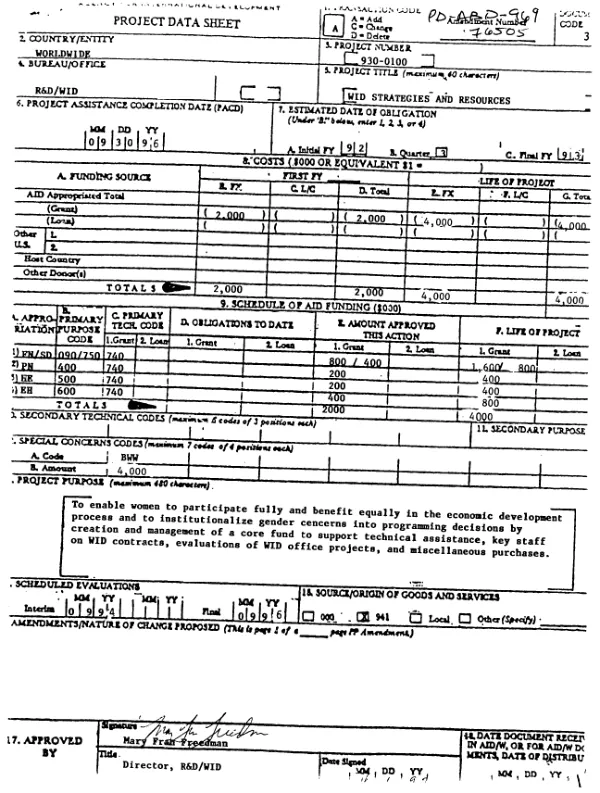
Project to increase African women"s participation in, and benefit from, development projects and programs by providing specialized TA on women"s issues to host governments, PVO"s, and Missions covering the entire gamut of project and program activities from strategy planning through implementation and evaluation.
1989
Sign in to readA free account is required to download.
Abstract
The project will initially be implemented in 6-9 priority countries, most likely Malawi, Botswana, Uganda, Rwanda, Mali, and Senegal. Candidates for later years include Swaziland, Madagasacar, Tanzania, Guinea, and Ghana. The project will be implemented by four long-term advisors -- one at each of the REDSO"s, the fourth in A.I.D./W -- assisted by short-term advisors. The regional advisors will: help ensure that activity designs maximize women"s participation and access to resources; design and/or undertake rapid rural appraisals to assess the scope of women"s participation in planned or ongoing efforts; locate and analyze gender-disaggregated data for use in program and project planning documents; and identify additional resources for more detailed attention to gender considerations. The Washington-based advisor will provide similar services, with a greater emphasis on coordination of assistance to the field. Training will be provided to key host country, PVO, and Mission staff. Much of the training will be on-the-job, e.g., analyzing gender-disaggregated data sets or developing gender-sensitive implementation plans with project teams. Some workshops will also be held. Where necessary and cost-effective, advisors will assist with developing scopes of work for baseline surveys and/or survey designs to ensure adequate attention to gender considerations. They will also assist target Missions in assuring that standard reporting documents include gender-disaggregated data. Quantitative targets include: improving WID databases in all 6- 9 target countries; completing gender assessments in at least 3 countries; completing project/program evaluations focusing on WID issues in all priority countries and in 3 others; and designing 30 projects with increased participation by women.
Related documents