USAID DEC
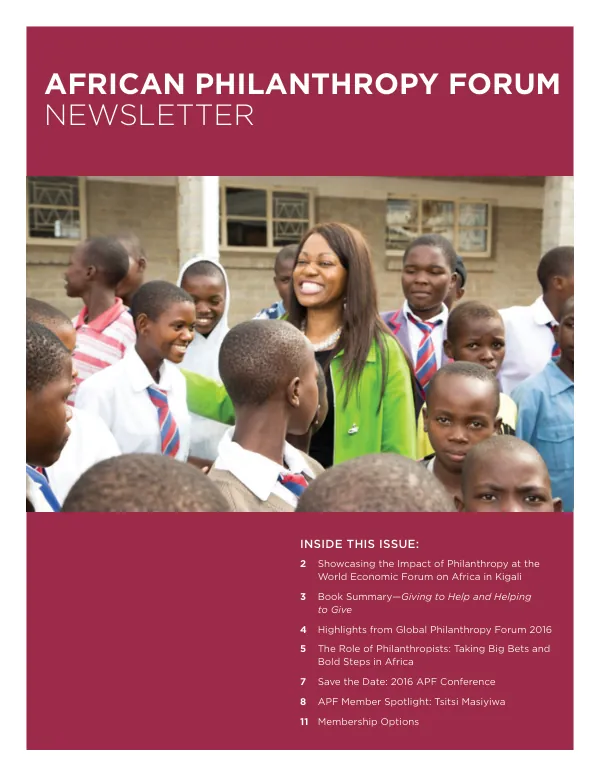
African Philanthropy Forum Newsletter June 2016
The African Philanthropy Forum (APF) is a learning community of African philanthropists and social investors committed to inclusive and sustainable economic development throughout the continent.
2016 · 14 pages
Sign in to readA free account is required to download.
Abstract
The APF aims to build a community of strategic philanthropists and social investors who share a common goal of addressing the root causes of injustice, want, ignorance, and disease in Africa. The APF is an affiliate of the Global Philanthropy Forum, a global community of donors and social investors committed to international causes. The APF's mission is to enhance the impact of its members' giving and investing through educational programs and matchmaking services. The organization's key activities include one-on-one outreach to current and emerging African philanthropists, convening an invitation-only conference in Africa every 12-18 months, regional outreach events throughout the year, and invitations to the annual Global Philanthropy Forum Conference held in the US. The APF also provides matchmaking services among donors and grantmakers. The APF enables its members to foster the growth of strategic philanthropy on the continent, learn about philanthropic investment opportunities and tested strategies, gain visibility for their philanthropic strategies and impact, serve as role models and inspiration to emerging philanthropists, meet and collaborate with other donors and social investors, and guide the development and direction of the APF as a peer-led organization. Participation in the APF is by invitation only and is open to emerging and established African donors and social investors who have made or plan to make a significant commitment to philanthropy. The APF hosted a reception for business leaders and social investors at the World Economic Forum on Africa in Kigali, where APF Director Ndidi Nwuneli provided insights into the APF's history and shared its vision to work as a catalyst for the 'Africa we want'. Alhaji Aliko Dangote, keynote speaker, reflected on his foundation's impact over the past 20 years and highlighted the importance of strategic philanthropy in Africa. Other speakers, including Elizabeth Tanya Masiyiwa of the Higherlife Foundation, Frannie Léautier of the Mkoba Private Equity Fund in Tanzania, and Rwandan social entrepreneur Joy Ndungutse, shared their experiences as philanthropists. The APF will host a series of private events in the months leading up to its conference, which will be held on October 17-18 in Rabat, Morocco. The conference will bring together current and emerging African philanthropists, grantmakers, and social investors to discuss the role of philanthropy in addressing the root causes of injustice, want, ignorance, and disease in Africa. The book "Giving to Help, Helping to Give" explores African philanthropic experiences, their varieties, challenges, and opportunities. The book is a pioneering effort in documenting, investigating, describing, analyzing, and reflecting on philanthropy in Africa. The book tackles the varied modes, forms, vehicles, and means in which philanthropy is expressed in multifaceted Africa. The Global Philanthropy Forum hosted its annual conference in Redwood City, California, on April 4-6, 2016, with the theme "People on the Move". The conference considered the implications of people moving at historically unprecedented rates, the conditions under which migrations occur, and the role that philanthropy can play in addressing the causes, enabling the transitions, and mitigating the impact. Several leaders from across Africa spoke during the conference, including Iyinoluwa Aboyeji, Impact Entrepreneur, Andela, and Tsitsi Masiyiwa, Founder and Co-chair, Higherlife Foundation. African philanthropists face immense pressure to give, with phone calls, emails, and letters from a broad range of stakeholders requesting help. The needs are diverse, and the pressure is often intense. Moved by compassion or compelled by the mounting pressure, the average African finds himself or herself supporting a range of causes, from paying school fees and covering hospital bills to digging boreholes and supporting community development projects.
Related documents