USAID. MISSION TO SENEGAL
AFRICARE/Peace Corps reforestation project
Evaluates Africare/Peace Corps community reforestation project in 40 villages in Senegal"s Diourbel region.
Lai, Chun K.; Sambou, Elie Joseph +1 more · 1983
Sign in to readA free account is required to download.
Abstract
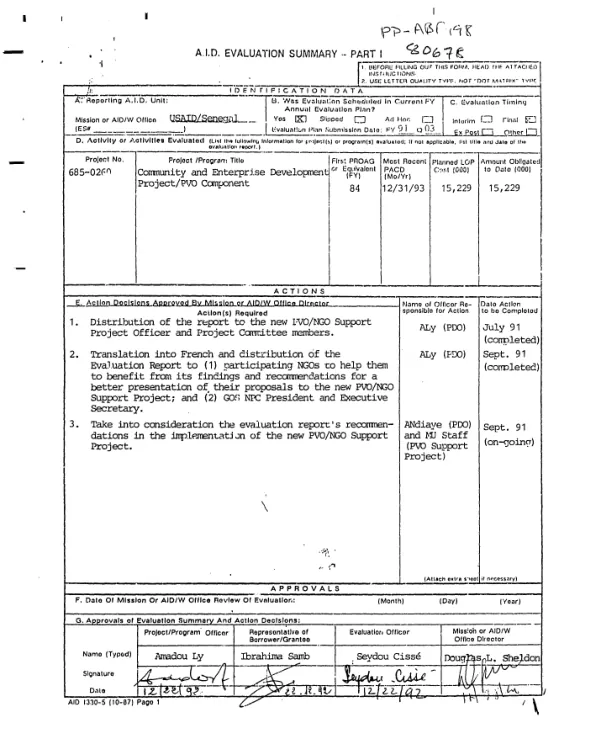
PES covers the period to 7/83 and summarizes an attached mid-term evaluation (XD-AAP-205-A) based on a review of project reports, interviews with project personnel, site visits, and consultation with researchers. The project has introduced, with PCV help, fuelwood production techniques in the Diorbel and Bambey departments and has laid a basis for villages to begin reforestation on their own, with training and nurseries provided in 38 villages to date. However, the project still awaits its first harvest and its benefits can only be estimated. In 1982, the second rainy season, the tree survival rate improved substantially (to 65%), with the mortality mainly due to the late installation of large mesh wire fencing. Recent activities include directing nursery efforts towards diversifying species and experimenting with indigenous species and seeking alternatives to mesh wire fencing. However, the protection of woodlots by building fences remains too costly; greater use of local technologies and materials is advised. The project should encourage private sector participation by introducing the sale of surplus seedlings and encourage individual woodlots where feasible. Over the next 2 years, PCV"s should introduce the AID-funded energy saving "Ban-Aksuf" woodstove in the project area. The World Forestry program introduced to the project as an incentive has been well received but needs to be carefully monitored. Lessons learned are that: Eucalyptus Camaldulensis proved generally unsuitable, while Prosopis Juliflora proved most drought resistant; the 1973 drought has made villagers acutely aware of the lack of wood for fuel and construction and has led them to integrate forestation with farming practices, although only the SERERE farmers have adopted new agroforestry methods; seedlings distributed for private planting had a higher survival rate and grew better; and religion has proven an asset in mobilizing land and human resources. Action decisions are to continue current activities under AFRICARE management to 12/83 and then, for FY 1984 under P.L. 480 Title III funding and under the direct management of Service des Eaux et Forets, with a focus on consolidating project efforts.
Related documents