USAID. MISSION TO SENEGAL
Community and enterprise development project/PVO component
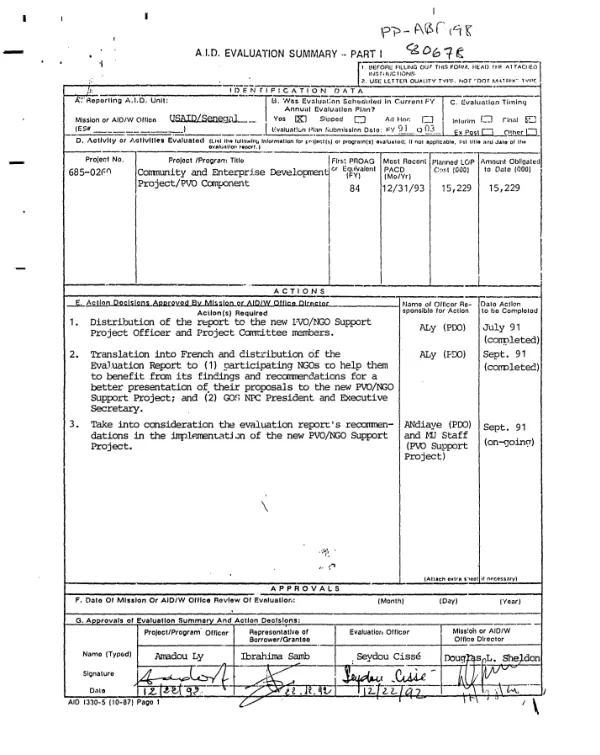
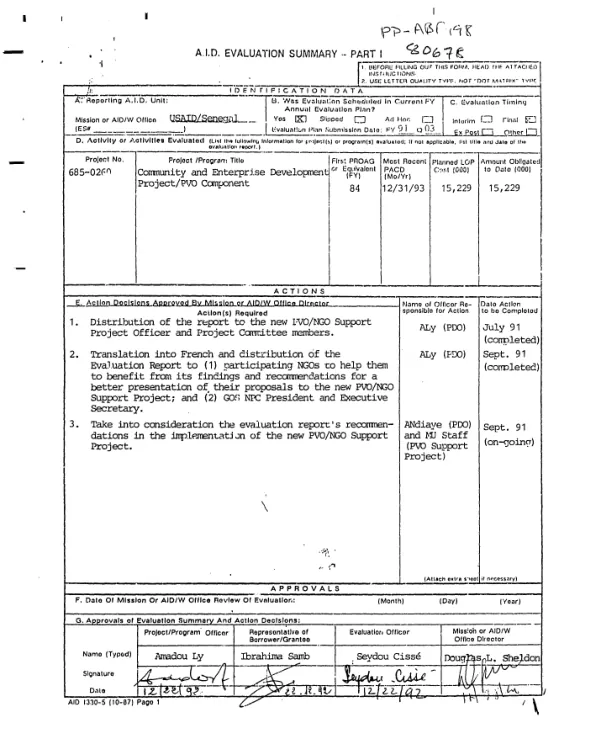
Summarizes final evaluation (XD-ABF-198-A) of a project component to work through PVO"s and NGO"s to strengthen the capacity of Senegalese village organizations (VO"s) to carry out local development projects.
1992
Sign in to readA free account is required to download.
Abstract
The evaluation covered the period 1/84- 12/90. A second component, aimed at developing small-scale enterprises (SSE"s), will continue until 12/93. This pilot project validated its hypothesis that PVO"s and NGO"s can supply technical, financial, and management services to meet the needs of small farmers. It also demonstrated the capacity of VO"s, when given time and appropriate assistance to manage their own development, made the Government of Senegal more willing to use PVO"s and NGO"s as agents of development, and showed PVO"s and NGO"s in Senegal that it is possible to work with A.I.D., even with all its regulations and requirements. The project also showed that credit is greatly needed to stimulate rural production and that under proper conditions, rural producer groups will accept and repay loans eagerly; in this project, 65% of the principal has been recovered so far. Eight PVO"s participated in the project, providing credit and training to 57 VO"s resulting in the generation of 114 local subprojects (SP"s). Though not mentioned in the Project Paper, the Village Education Program proved a highlight. As a result of this high-quality program, VO members became very conversant with matters of credit, loans, interest, repayment rates, and business management. The most thoroughly trained groups showed high levels of comprehension and group cohesiveness, suggesting that a functional literacy and training program could ensure long-term sustainability of VO"s. Despite the project"s overall success, design and management problems make it very difficult to judge definitively whether PVO"s and NGO"s can provide effective support to VO"s. (1) Due to an overly ambitious implementation schedule, activities were initiated before PVO"s/NGO"s and VO"s were fully ready. The PVO component also suffered from being coupled with the SSE component. (2) Implementation was hindered by a cumbersome, rigid SP approval process. Early on, the PVO component ceased being a rural development project, as originally envisioned, and became credit and repayment driven. Innovative income-generating activities were not encouraged by this policy, and in the end, only animal fattening SP"s offered reasonable success in terms of loan repayment and short term profitability as required by the project. (3) The National Project Committee (NPC), originally limited to policy and monitoring decisions, later became an SP approval committee, slowing implementation. (4) USAID/S pulled back from its envisioned technical and managerial support, giving more responsibility to the Management Unit (MU); the MU, however, was understaffed for this task and weak in certain technical areas, resulting in many poorly designed SP"s. The project points out the inherent complexity of PVO/NGO umbrella projects, with their multiple partners and levels of intervention. The project designers did not fully appreciate these complexities, while project managers and implementors grappled with them, sometimes unsuccessfully -- but sometimes, as in the case of the Village Education Program, with great success. Perhaps the most fundamental lesson is the importance of basics: coherence in objectives and outputs; clarity in roles and relationships; consistency in adapting design into implementation; flexibility in course corrections; and care in understanding stakeholders" needs and capabilities. The following lessons were also learned. (1) Project design should remain simple, with a limited number of diverse components and layers of bureaucracy, and clearly defined institutional roles. (2) An 8-10 year timeframe is required for a PVO/NGO umbrella project involving substantial institution building. (3) The MU"s personnel level must realistically reflect the scope and volume of its responsibilities. (4) Inter-agency learning and coordination should be an integral element in any umbrella project. The Mission found the evaluation worthwhile and decided to use most of its recommendations in implementing its new PVO/NGO Support Project. It notes, however, that the evaluation failed to incorporate Mission comments on two key issues: the nature of host government NPC members" involvement in management decisions, and women"s participation in the project.