USAID. MISSION TO EL SALVADOR
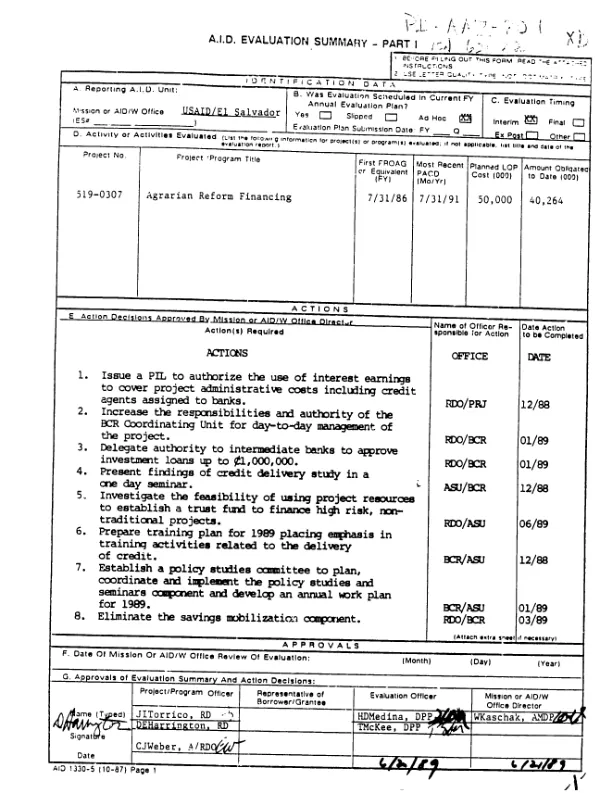
Agrarian reform financing
Summarizes attached final evaluation (XD-ABE-656-A) of a project to provide credit to agrarian reform cooperatives and individual farm families in El Salvador.
1991
Sign in to readA free account is required to download.
Abstract
Most of the project"s objectives were achieved. Major accomplishments include the following: (1) a credit delivery system was put in place and $57.3 million was loaned to targeted clientele; (2) thousands of loans were granted (682 to 195 agrarian reform cooperatives, and 2,671 to 3,679 small and medium farmers); (3) $48.3 million of the rediscount line was used as of 3/31/91, which included funds that were lent, repaid, and relent, with a collection rate of over 98% (approximately $25 million has not been utilized); and finally (4) a cadre of technicians were trained and became increasingly skilled. Improvements to the system over the life of the project demonstrated that initial slow performance can be improved. The evaluation team considers the fact that only 28% of the funds lent were used for medium-term investment loans to be a shortcoming. However, the project has recently been amended to include a loan guarantee fund; this fact coupled with the recent approval of Banco de Fomento Agropecuario (BFA) as a participating financial institution, should improve performance in this area (should the project receive the two-year recommended extension). Lessons learned include two observations: (1) despite the high quality of a given delivery system, participating financial institutions (PFI"s) cannot be forced to make loans to borrowers whom they consider not creditworthy; therefore (2) upgrading the creditworthiness of borrowers, a long-term process, is essential if PFI"s are to be induced to lend.
Related documents