USAID DEC
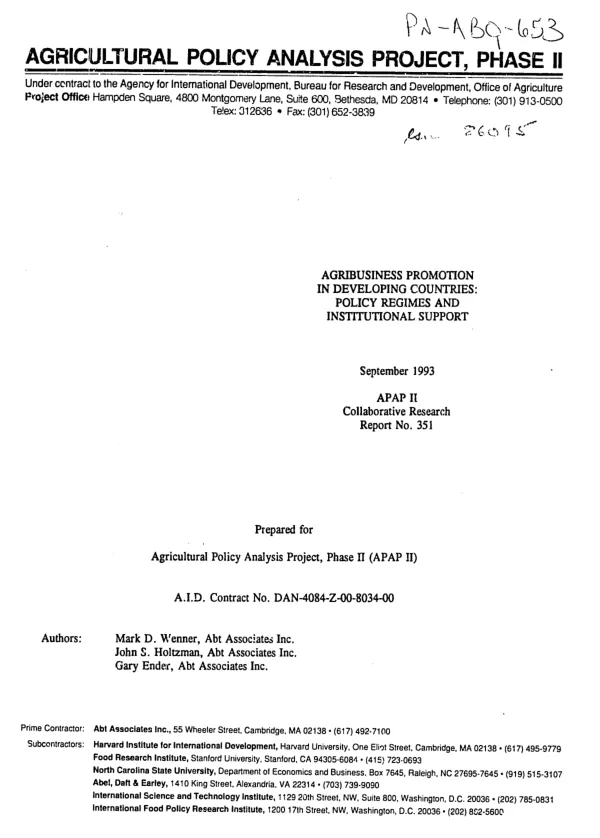
Agribusiness promotion in developing countries : policy regimes and institutional support
Sign inABT ASSOCIATES, INC.
Agribusiness promotion in developing countries : policy regimes and institutional support
This paper reviews the policy and institutional factors needed to launch and sustain an agribusiness export promotion campaign.
Wenner, Mark D.; Holtzman, John S. +1 more · 1993
Sign in to readA free account is required to download.
Abstract
It is directed to policymakers in small open economics as well as donor officials. The paper examines in detail first and second-best economic policy instruments, and the most appropriate roles for public and private sector actors in supporting agribusiness development. The main policy objectives are: a flexible and realistic exchange rate; a liberal trade regime; competitive primary input markets; competitive financial markets; a nondiscriminatory tax system; and a transparent and rational regulatory system. Institutionally, the goal is to foster a set of units that collaborate in a consistent manner to provide an enabling environment. The organization of the paper is as follows. Chapter 2 discuses methodologies for determining competitiveness and identifying commodities with high growth potential or subsectors for investment, as well as measures of incentive bias. Chapter 3 outlines appropriate roles for the public and private sectors and discusses the government"s role in setting realistic exchange rates, pursuing sound macroeconomic policies, investing in the basis infrastructure needed to initiate an export campaign and attract foreign investment, and coordinating and regulating an agribusiness system in collaboration with the private sector. Chapter 4 addresses trade finance as a means of overcoming financial market impediments and the need for automatic access to credit. Chapter 5 examines firm-level interventions, while Chapter 6 highlights areas for further research. (Author abstract)
Related documents
![Impact of trade liberalization on the Philippine economy : a CGE [computable general equilibrium] modeling approach](https://covers.devme.ai/gen/14535.webp)