ABT ASSOCIATES, INC.
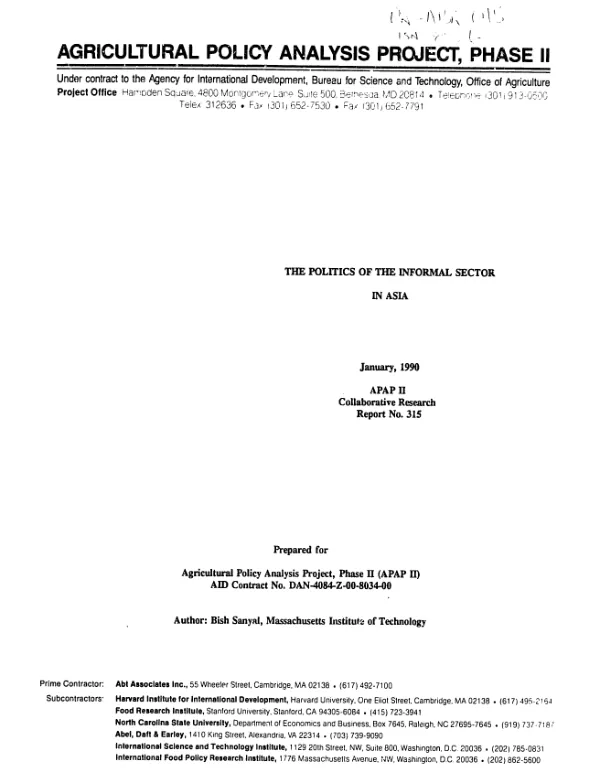
Politics of the informal sector in Asia
The informal sector (IS) is not a new phenomenon.
Sanyal, Bish · 1990
Sign in to readA free account is required to download.
Abstract
Its emergence was noted as early as 1963 and since then much research has been conducted about its role in developing countries. The emphasis of this research has been on the economic aspects of IS; as yet, we know very little about its politics. Additionally, the scanty research that has been done on the topic is, with one or two exceptions, based on Latin American experiences. This report takes into account these limitations by drawing on articles and books on Asian cities that refer to IS politics even in the passing. Such references constitute a considerable amount of information and suggest that IS, particularly in the urban areas, is a growing political force in many Asian countries; and that the nature of IS politics is shaped by characteristics that are unique to the process of urbanization, industrialization, and political modernization. The report is divided into three parts. The first provides background material on IS in Asia. We begin by discussing some popular myths about the IS, then provide estimates of its magnitude, and list its unique characteristics in Asia. The second part focuses on the political aspects of IS. We identify the various elements which influence the nature of its politics, describe the ideology of its participants, and analyze the factors which facilitate and/or hinder political mobilization by the participants. The third part of the report highlights the IS"s political relationship with three dominant social institutions -- namely, the government, political parties, and organized formal-sector labor. The purpose is to identify the kind of politics which would make governments remove regulations that currently hinder IS activities and institutionalize, in a permanent way, the IS"s influence on policy making. (Author abstract)
![Impact of trade liberalization on the Philippine economy : a CGE [computable general equilibrium] modeling approach](https://covers.devme.ai/gen/14535.webp)