USAID DEC
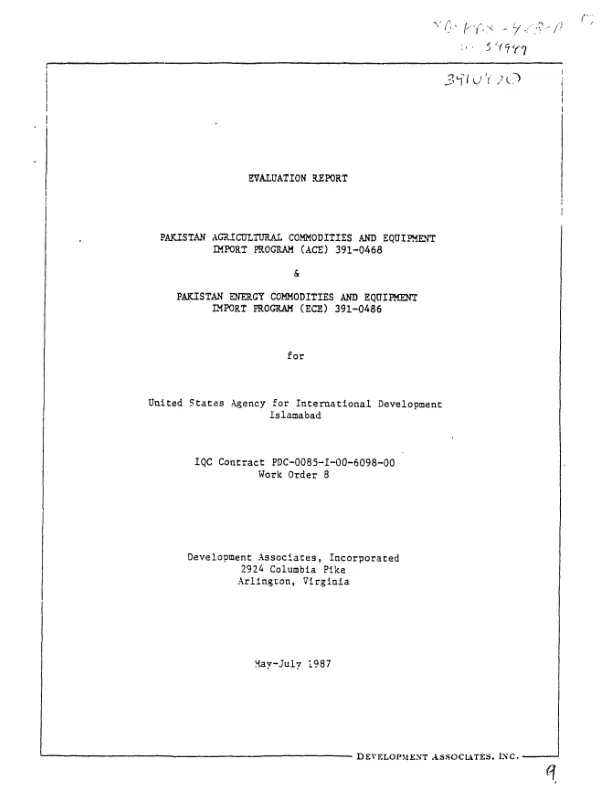
Agricultural commodities and equipment program [and] energy commodities and equipment program
Sign inUSAID. MISSION TO PAKISTAN
Agricultural commodities and equipment program [and] energy commodities and equipment program
Summarizes attached external evaluation of two sector-specific commodity import programs (CIP"s) for Pakistan, one for agriculture and the other for equipment and energy commodities.
Siegel, Stanley J.; Allen, C. Blair · 1988
Sign in to readA free account is required to download.
![Agricultural commodities and equipment program [and] energy commodities and equipment program](https://covers.devme.ai/gen/19340.webp)
Abstract
Interim evaluation covered the period through 1/88 and was based on document review, site visits and interviews with involved personnel. The CIP"s are proceeding well, except for difficulties with private sector imports. The initial design stressed rapid disbursements for balance of payments support and included private sector windows in both programs. However, both windows (totaling $50 million) remain virtually unused because of high U.S. product costs, the availability of other foreign exchange, increased competition for markets by other countries, and regulatory restraints imposed by the Government of Pakistan (GOP). Public sector funds, on the other hand, are in great demand; GOP agencies are not greatly concerned with dollar costs and there is pressure on them to utilize CIP funds. Over 80% of the agricultural funds have been used for fast-moving bulk commodities - wheat, cotton, and fertilizers, with the remainder designated for agricultural equipment for seven A.I.D. projects. The energy and equipment CIP, which has been aimed at power, oil, gas, and coal, had disbursed $9.7 million of the $100 million obligated, and another $50 million has been committed to various transactions. The CIP"s are playing an important role in policy dialogue and the development impacts of CIP imports are expected to be high. Overall, both CIP"s are managed efficiently by USAID/P and coordination with the GOP is effective. Major bottlenecks have occurred, however, on the GOP side in drafting specification and evaluation bids; substantial TA and training are required. Public sector activities in both programs should be continued. The private sector windows should be continued for at least 6 months to allow time to (1) reexamine their viability (vis a vis the staff time spent promoting them) and (2) determine empirically the effect of lowering interest rates for importers. Also, another evaluation should be conducted in Spring 1988 to assess the utilization and development impact of the balance of the imported machinery and equipment. The major lessons learned are: (1) USAID"s and A.I.D./W should be wary about burdening CIP"s with rapid disbursement objectives when their commodity content makes them more suitable for development (this is particularly true for sector-oriented CIP"s); and (2) designers of private sector windows should analyze the real demand for private participation more carefully, taking into consideration the availability of foreign exchange, the competition for U.S. commodities, and the outselling and outservicing of U.S. firms by others, particularly Japan. (Author abstract, modified)
Related documents
Documents in this collection
 1987
1987USAID DEC
Evaluation report : Pakistan agricultural commodities and equipment import program (ACE) 391-0468 and Pakistan energy commodities and equipment import program (ECE) 391-0486
Open record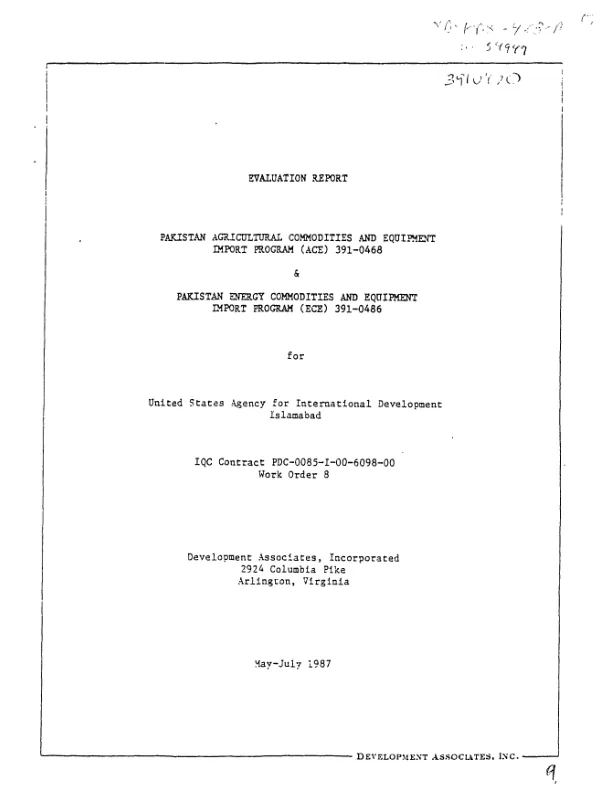 1987
1987USAID DEC