USAID DEC
Project assistance completion report : agricultural sector support program (391-0492)
Sign inUSAID. MISSION TO PAKISTAN
Project assistance completion report : agricultural sector support program (391-0492)
PACR of a program (9/87-3/95) to encourage the adoption of agricultural policy and institutional reforms in Pakistan.
1995
Sign in to readA free account is required to download.
Abstract
The program consisted of sector grants, a Commodity Import Program (CIP), and training and TA. The program succeeded in laying the groundwork needed for Pakistan to privatize its agricultural sector. The Government of Pakistan (GOP) has succeeded in carrying out a number of major agricultural reforms, although more work needs to be done before the sector is fully privatized. Despite premature curtailing of the sector grant component by the Pressler Amendment, the component achieved 83% of its targets, including reductions in the subsidies for phosphatic and potassic fertilizers, reduction in state procurement of domestic wheat, and increased public sector recovery of wheat storage and handling costs. The private sector is now allowed to import corn and to export basmati rice, cheese, and some milk. A truth-in-labeling law was enacted, a bill on plant breeders" proprietary rights is under review, and a policy of no interest on small agricultural loans was replaced with a system of recovering at least administrative costs. The public sector CIP financed imports of 321,000 MTs of wheat, which provided direct balance of payments support of $59.2 million and budgetary support of Rs. 675 million from sale proceeds. These funds were programmed to finance development activities in the agricultural, health, and education sectors. In addition, bulldozers were imported for Northwest Frontier Province, where they are rented to farmers, and bulk wheat handling equipment was imported and used in a pilot activity. Under the private sector CIP, $17.7 million worth of agribusiness equipment and commodities were imported. The training and TA component contributed significantly to strengthening human resources, public and private. Ph.D., M.S., and postdoctoral training was provided mainly for university faculty, while short-term training focused on private agribusinesses. Substantial amounts of TA were provided in economic and policy analysis; the TA program included a very productive special studies program which has been instrumental in redirecting Pakistan"s agricultural policies, as well as significant activities in the areas of storage technology, agricultural data collection, and agribusiness promotion. By focusing on sectoral and structural reforms that in many ways replicated the conditionalities of the IMF, the World Bank, and other bilateral donors, the program enhanced its prospects for long-term sustainability. The following lessons were learned. (1) Missions implementing a policy reform agenda must have a high level of policy analysis capability available to them. Persons responsible for analyses should not have implementation responsibilities, because the pressure of implementing often takes precedence over analysis. (2) USAID/P"s leverage for compliance on policy benchmarks was limited because of the promised multi-year package of assistance. (3) Design flexibility in the CIP was helpful in financing emergency imports. (4) The training component should have: required USAID staff to work closely with cooperating institutions in nominating candidates; made the selection process competitive for both public and private sectors; focused agribusiness training on fewer areas; included more in-country training; included private sector representatives in the selection process; emphasized institutional linkages; and, for academic training, had U.S. universities participate as placement facilitators. (5) Regarding TA, USAID financing of operational costs should be phased out gradually (and host government funding phased in) rather than stopped abruptly at the end of a project; withdrawal of project funding should have been more gradual. In addition, instituting a pilot-tested technology can be time-consuming, clearances from security conscious government agencies should be obtained at the design stage, and detailed industry studies and analyses of complex issues can help in policy dialogue with the government. (6) Host government officials should be involved in major donor-assisted activities even when the projects relate to development of the private sector; a full-time resident expatriate supervisor should be on staff to monitor and guide implementation; and host government officials should be briefed fully on the benefits of project activities, especially while creating new institutions.
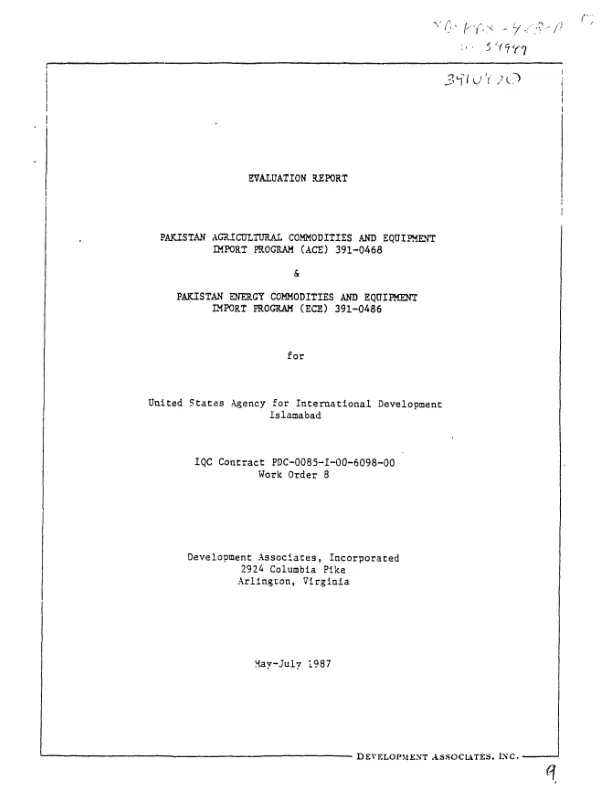
![Agricultural commodities and equipment program [and] energy commodities and equipment program](https://covers.devme.ai/gen/19340.webp)