DAI
Agricultural Credit Enhancement (ACE) II Program Monthly Report No.6, December 2015
The Agricultural Credit Enhancement II (ACE-II) program continued its efforts to implement activities in line with the Annual Work Plan during December 2015.
2015 · 18 pages
Sign in to readA free account is required to download.
Abstract
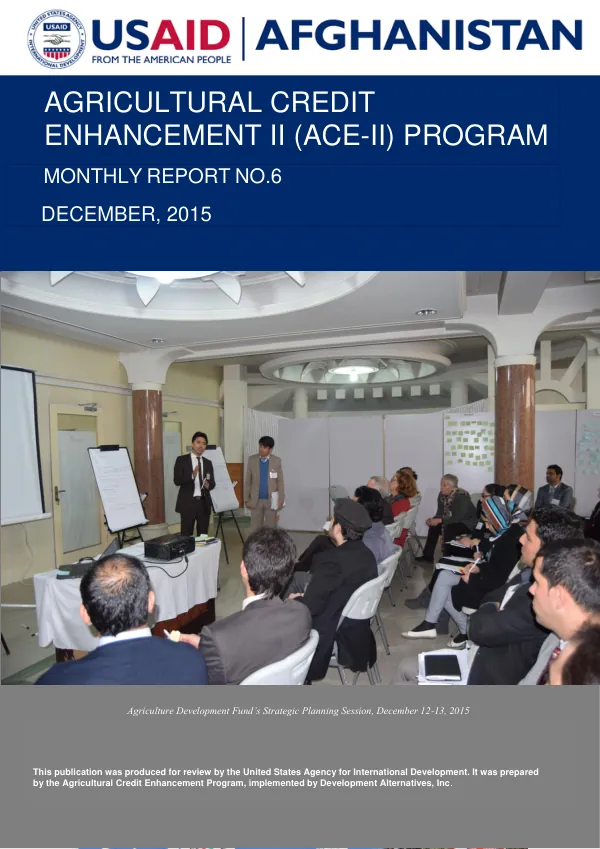
The program's progress included the completion of a review of Agriculture Development Fund (ADF) management performance. Mr. Robert Dressen, Senior Financial Advisor, conducted a capacity assessment of the ADF executive team to measure their performance and identify areas for improvement. The assessment revealed that the ADF executive directors need to think more like executives and leaders, and they need to better understand the ADF Five Year Strategy and participate in developing the new Five Year Plan. The review also highlighted the importance of strengthening collaboration and partnership with MAIL's new leadership, as well as reinforcing the governance structure of the High Council and its Committees. The ACE-II technical team participated in the ADF Strategic Planning Session, held on December 12-13, 2015, with the participation of both national and provincial ADF staff. The session aimed to develop team-wide ownership of the strategy, objectives, priorities, and targets by facilitating discussion of issues and challenges facing the ADF. The underlying objective of Component 1 is to provide technical assistance and advisory support to ADF management and operating units, with particular focus on corporate governance and internal operations. The ADF Strategic Planning Session was designed to develop a shared "vision of success" for the ADF, which will inspire and guide management choices. The session included interactive participation, such as break-out groups and exercises, to identify the unique qualities and achievements of the ADF. The results from the interactive session will be presented to the ADF team in early January 2016. Two Short-Term Technical Assistance (STTA) experts, Michelle Breton and Robert Dressen, arrived in Afghanistan to conduct the review of performance of the ADF executive team and the assessment of ADF operations. Ms. Breton's review covers various ADF operational areas, including business development, credit and risk management, finance, operations, and administration, as well as internal auditing. Mr. Dressen's tasks included reviewing the performance of the ADF staff, particularly the executive team and the heads of departments. The STTAs have separate responsibilities but will collaborate on some parts of the ADF review to address activities outlined in the Annual Work Plan. The review process applied a self-assessment approach, individual meetings, coaching, documents review, and observations. The assessment revealed that the ADF executive directors need to think more like executives and leaders, and they need to better understand the ADF Five Year Strategy and participate in developing the new Five Year Plan. The ACE-II program also continued to support the ADF's transition to an independent financial institution. The transition integrates several dimensions of independence, including financial, institutional, and operational. The program aims to achieve these objectives and ultimately lead to underpinning the independence and sustainability of the ADF. The ACE-II technical team participated in the Solutions Committee of the Agricultural Credit Technical Working Group (ACTWG) meeting on December 22 to finalize the agenda for the ACTWG's January meeting. The DCOP recommended by DAI was approved by USAID and arrived in Afghanistan on December 10th, 2015 to commence duties. The program also conducted a Data Quality Assessment (DQA) on selected ACE-II performance indicators on December 7th, 2015 to identify the strength and weaknesses of the data reported to USAID on the program's success. The assessment confirmed the quality of the ACE II reported results. The program also drafted the Annual Program Statement (APS) and Request for Applications (RFA) following the approval of the Innovation Grant Fund (IGF) Manual. The APS and RFA were prepared and submitted to the USAID for further review and approval.