DEVELOPMENT ALTERNATIVES, INC./FINNET
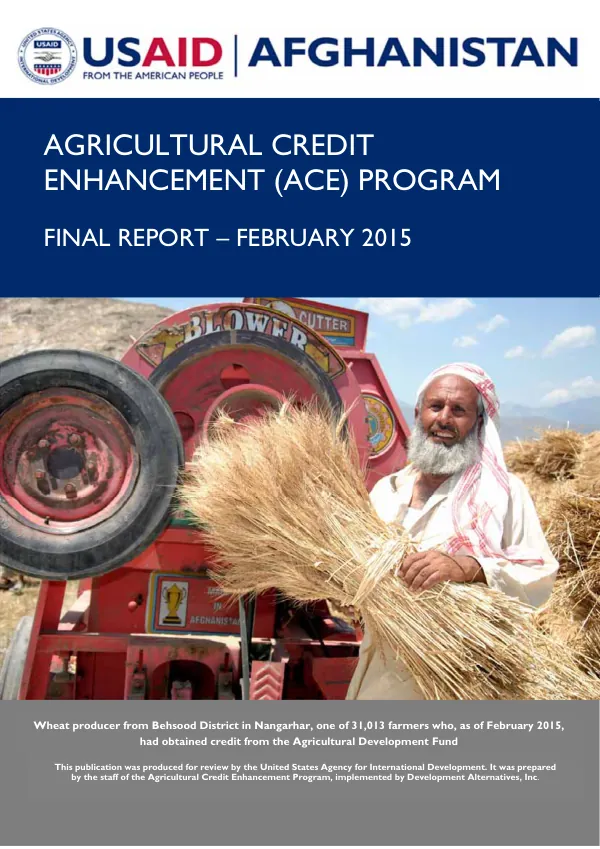
Final Report: Agricultural Credit Enhancement Program
The Agricultural Credit Enhancement (ACE) Program was established to provide credit to farmers and agribusiness entrepreneurs in Afghanistan.
2015 · 64 pages
Sign in to readA free account is required to download.
Abstract
The program was implemented by Development Alternatives, Inc. and was funded by the United States Agency for International Development. As of February 2015, the program had provided credit to 31,013 farmers, with a cumulative loan value of US$106 million. The ACE Program focused on three key components: delivery of credit services, value chain strengthening, and knowledge management. In terms of credit delivery, the program established the Agricultural Development Fund (ADF), a wholesale lending institution under the Ministry of Agriculture, Irrigation and Livestock. The ADF provided credit to farmers and agribusiness entrepreneurs through a variety of intermediaries, including financial intermediaries and private intermediaries. The program also implemented a number of initiatives to strengthen the value chain, including training programs for farmers and agribusiness entrepreneurs, as well as market information and intelligence products. Additionally, the program established a number of financial products, including loans and grants, to support the development of the agricultural sector. The ACE Program achieved a number of significant results, including a 57% average increase in income for households benefiting from credit, and the creation of 4,016 full-time jobs. The program also reported a 27% increase in the value of exports for firms supported by ACE, and the establishment of 1,356 jobs for women. The program's default rate was 4.5%, and the average value of loans disbursed was US$3,400. The program's geographic distribution of borrowers and loan disbursements was widespread, with borrowers located in all 34 provinces of Afghanistan. The program also reported a significant increase in the number of female borrowers, with 38% of all borrowers being women. The program's training programs for farmers and agribusiness entrepreneurs were also highly successful, with over 4,000 individuals trained in credit, operations, value chain theory, and management information systems. The ACE Program's results were evaluated against a number of performance targets, including the value of finance accessed through lending, the number of individuals benefiting from financial agreements, and the percent increase in household income by assisted direct beneficiaries. The program's results were also compared to a control group, and the program reported a significant increase in household income and job creation compared to the control group. Overall, the ACE Program was highly successful in achieving its objectives of providing credit to farmers and agribusiness entrepreneurs in Afghanistan, and in strengthening the value chain of the agricultural sector. The program's results demonstrate the potential for credit programs to have a significant impact on the development of the agricultural sector in Afghanistan.