ACDI/VOCA
Agricultural Credit Enhancement (ACE) Program: Quarter 3 FY2014
The Agricultural Credit Enhancement (ACE) Program, implemented by Development Alternatives, Inc., is a project aimed at revolutionizing Afghan agriculture by establishing and managing the Agricultural Development Fund (ADF), a wholesale lending institution under the Ministry of Agriculture, Irrigation and Livestock.
2014 · 43 pages
Sign in to readA free account is required to download.
Abstract
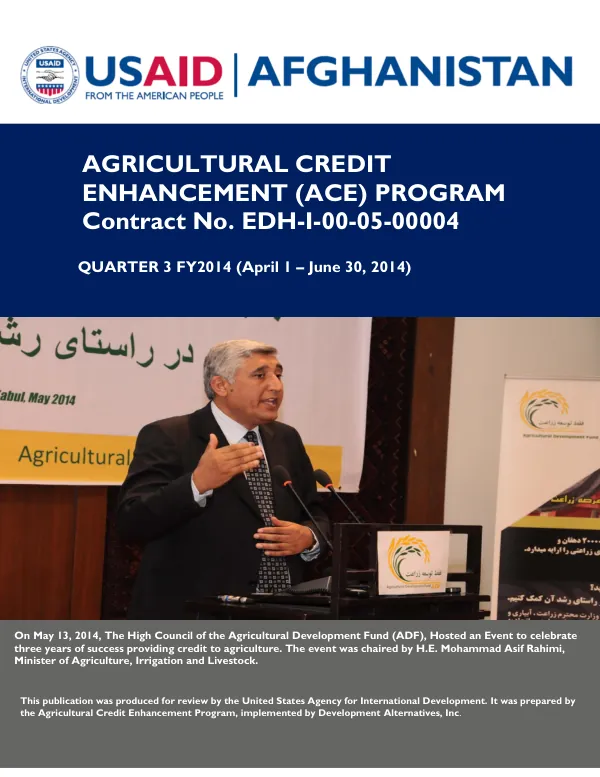
The ADF provides credit to farmers and agribusiness entrepreneurs through various intermediaries, with the goal of increasing agricultural productivity and economic growth. The ACE Program is organized into three components: Delivery of Credit Services, Agricultural Modernization and Value Chain Development, and Coordination and Knowledge Management. The Delivery of Credit Services component focuses on establishing the ADF as a non-bank financial institution, regulated by Afghan law and guided by the High Council. The ADF partners with non-financial institutions and agribusinesses to provide credit to farmers. The Agricultural Modernization and Value Chain Development component provides technical support to lending operations and to ADF clients. This unit leads the technical assessment of loan applications and provides technical assistance to ADF borrowers. The Coordination and Knowledge Management component integrates production and market information to transform it into market intelligence, using the PAYWAND agricultural information platform. During the reporting quarter, the High Council of the ADF approved the nomination of Joel Carter as the acting Chief Executive Officer of the ADF. The board also approved a new member, Moeenuddin Siraj, and accepted the appointment of four Afghan National ADF directors. The ADF received its first transfer from the Danish Ministry of Foreign Affairs, amounting to US$3.5 million, as part of a total contribution of up to US$32 million. The ADF continues to explore other funding opportunities for the capitalization of the lending fund. On May 13th, the ADF High Council hosted an event to celebrate the success and achievements of the Fund in the past three years, welcoming the Government of the Kingdom of Denmark as a contributor to the ADF. The celebration included recognizing a small group of outstanding clients with prizes handed by the High Council members. ACE transferred 39 employees to the ADF, including technical directors, lending advisors, credit and administration officers, finance staff, value chain specialists, auditors, and monitoring and evaluation officers. The ADF now has a fully operational financial institution, regulated by law and policies, with its own staff and assets, indicating its operational readiness to provide access to agricultural credit. In the last quarter, the ADF approved eleven new loans worth US$6 million and disbursed US$7.4 million to existing clients, benefiting approximately 4,000 new direct beneficiaries. Currently, intermediaries and agribusinesses engaged in on-lending have reached out to 24,565 farmers who have directly benefited from agricultural credit. The ADF portfolio at risk is at 3.66 percent, widely accepted in the financial sector. The loan retention rate increased from 75 percent to 81 percent in the last quarter, indicating a positive effect on institutional cost, staff productivity, and loan risk. ACE distributed fertilizers on credit to member farmers of Bamyan Cooperatives and supported potato growers in Bamyan through three separate loans of a total of US$2.2 million to 39 cooperatives in four districts.