AFGHANISTAN MINISTRY OF AGRICULTURE, IRRIGATION AND LIVESTOCK
Agricultural Credit Enhancement (ACE) Program Quarterly Report Q3 FY 2011
The Agricultural Credit Enhancement (ACE) Program in Afghanistan has made significant progress in its third quarter, April 1 – June 30, 2011.
2011 · 31 pages
Sign in to readA free account is required to download.
Abstract
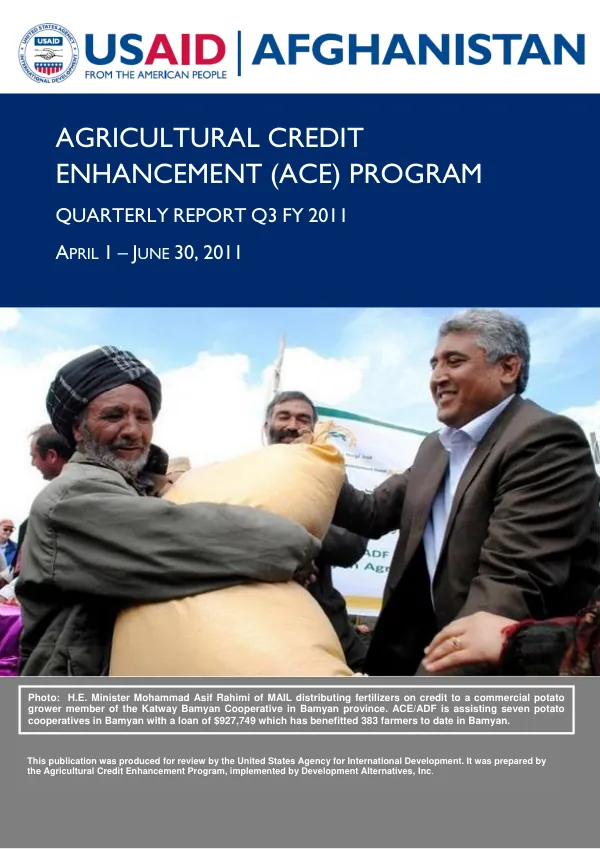
The program has directly benefited 5,528 farmers in 17 provinces through agricultural inputs on ADF credit and advance payments. ACE has worked with 14 intermediaries to extend credit to farmers, with $16 million USD formally approved by MAIL and USAID, and approximately $4 million USD pending final MAIL Minister approval. During the reporting quarter, ACE organized two public events for the distribution of agricultural inputs on credit to members of the Eastern Region Fruit Growers Association (EFGA) in Nangarhar Province and members of seven potato cooperatives in Bamyan. These events were attended by high-ranking government officials, including H.E. Deputy Minister Ghuriani of MAIL and H.E. Ambassador Eikenberry. Minister Rahimi expressed his appreciation for the ACE/ADF work on extending credit to commercial farmers, who are discriminated against by commercial banks. ACE has promoted the Murabahah markup sharing Islamic financial product for loans approved for EFGA, Season Honey Processing Company, and Afghanistan. The project is designing another product, Murabahah – profit sharing, for new borrowers such as Sayed Jamal Flour Mill and Red Gold Saffron Company. These products will be launched in the next quarter when the loans are formally approved by MAIL and USAID. The ADF Credit Committee approved the loan package for Afghan Dost Sharq, a poultry company, worth $3,750,000 to finance the purchase of equipment. The loan is currently awaiting MAIL Minister approval. The loan package for Sayed Jamal Flour Mill was presented twice to the ADF Credit Committee in this past quarter, with the ADF proposing to reduce the loan from $3 million to $2 million USD due to concerns about potential fluctuations in wheat prices. ACE has achieved several milestones in the third quarter, including obtaining MAIL/USAID approvals for $16 million in loans to financial and non-financial intermediaries, benefiting directly 5,528 farmers through agricultural inputs on ADF credit and advance payments, and launching a modified version of Murabahah as a financial product aimed at the provision of credit for the purchase of agricultural inputs. ACE has also signed an agreement with M-Paisa for the use of mobile banking services for loan repayment and developed and launched the concept of Credit Management Units (CMUs) as support mechanisms for non-financial intermediaries. The Value Chain Strengthening unit has carried out a three-fold mission, assisting the lending team to assess the technical feasibility of loan packages in the pipeline, assisting with the implementation of ADF lending activities through value chain information, and assisting ADF borrowers with sales and the penetration of new markets. The Market Information unit has published the new market brief on melons/watermelons and prepared the 2010 (1389) Agricultural Trade Report for Afghanistan. The unit has also shown exponential progress in the development of the Knowledge Management Facility (KMF), which will host agricultural and meteorological data and specific agricultural studies carried out by several development programs. The Monitoring and Evaluation Unit has conducted due diligence through field monitoring and inspections for the distribution of ADF loans to the end borrowers, particularly focusing on farmers. Distribution of agricultural inputs to members of AAIDO, EFGA, and Bamyan potato cooperatives yielded positive results, showing that the program's non-financial intermediaries have operated effectively. Finally, ACE launched the Agricultural Credit Shura as an instrument of enhancing awareness for ADF lending opportunities and Islamic compliant financial products.