AFGHANISTAN MINISTRY OF AGRICULTURE, IRRIGATION AND LIVESTOCK
Agricultural Credit Enhancement (ACE) Program Quarterly Report Q2 FY 2014
The Agricultural Credit Enhancement (ACE) Program, implemented by Development Alternatives, Inc.
2014 · 58 pages
Sign in to readA free account is required to download.
Abstract
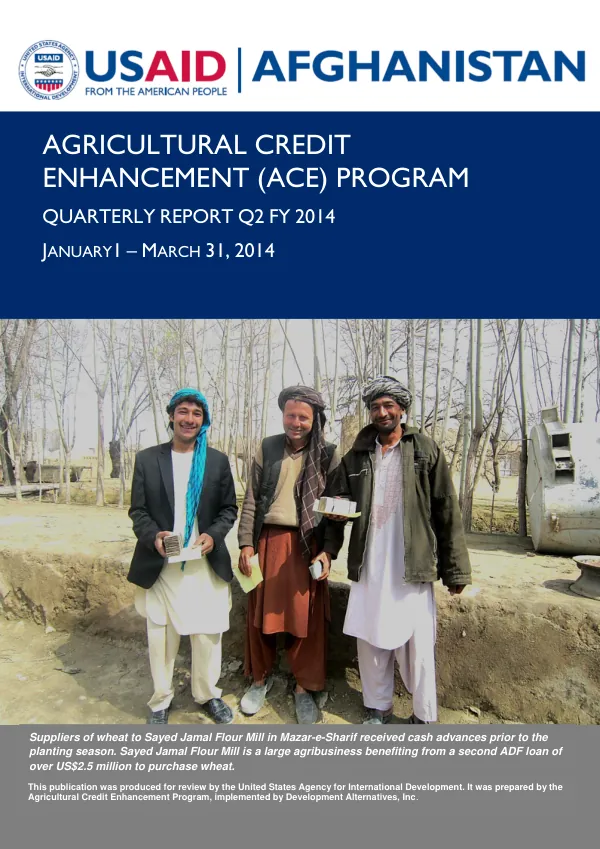
(DAI), continues to play a significant role in supporting large agribusiness investments in Afghanistan's agricultural sector. The program's primary objective is to establish and manage the Agricultural Development Fund (ADF), a wholesale lending institution under the Ministry of Agriculture, Irrigation and Livestock, to provide credit to farmers and agribusiness entrepreneurs. The ADF has made significant progress in consolidating its position in the Afghanistan credit market, particularly in supporting large agribusiness investments along the main agricultural value chains. The program has expanded production capacity, improved market efficiency, and strengthened market links with local producers. The ADF has also contributed to import substitution of inputs and raw materials, which is crucial in a context where most financial institutions provide microcredit services or commercial loans at high interest rates. The ADF has achieved notable milestones, including the appointment of Joel Carter as the CEO and the approval of the ADF business plan for the next five years. The program has also seen an increase in client retention rates, from 67 percent to 75 percent, and a significant shift towards Sharia products, with 57 percent of disbursed loans now consisting of Sharia products. Additionally, the program has organized workshops on agricultural export procedures and policy, established four daycare centers in Bamyan for the children of carpet weavers, and published four agricultural trade reports. The ADF has also demonstrated its commitment to socially responsible practices, particularly in the carpet industry. The program has provided loans to female weavers, enabling them to purchase raw materials and sell their carpets to the highest bidder. This initiative has given women economic freedom and has also provided them with access to basic medical and ophthalmology services. The ACE program has also supported the development of the agricultural sector through various initiatives, including the provision of loans to farmers and agribusiness entrepreneurs. The program has also established partnerships with various stakeholders, including the Ministry of Agriculture, Irrigation and Livestock, and the USAID, to ensure the sustainability of the ADF and its continued growth. The ADF has a portfolio at risk of 4.62 percent, which is a desirable rate for the financial sector in the West. The program has also seen an increase in job creation, with ADF clients creating 235 jobs in full-time equivalent (FTE) during the reporting quarter, and a total of 2,734 jobs from the start of the project. The program's achievements have been recognized by the Danish Ministry of Foreign Affairs, which has committed to providing an additional US$28.5 million over the next three years to contribute to agricultural lending and economic growth in Afghanistan. The ACE program's success is attributed to the expertise and talent of the ACE team and DAI as the implementing partner. The program's commitment to socially responsible practices and its focus on supporting the agricultural sector have made it a valuable partner in Afghanistan's economic development.