UNIVERSITY OF WISCONSIN AT MADISON. LAND TENURE CENTER (LTC)
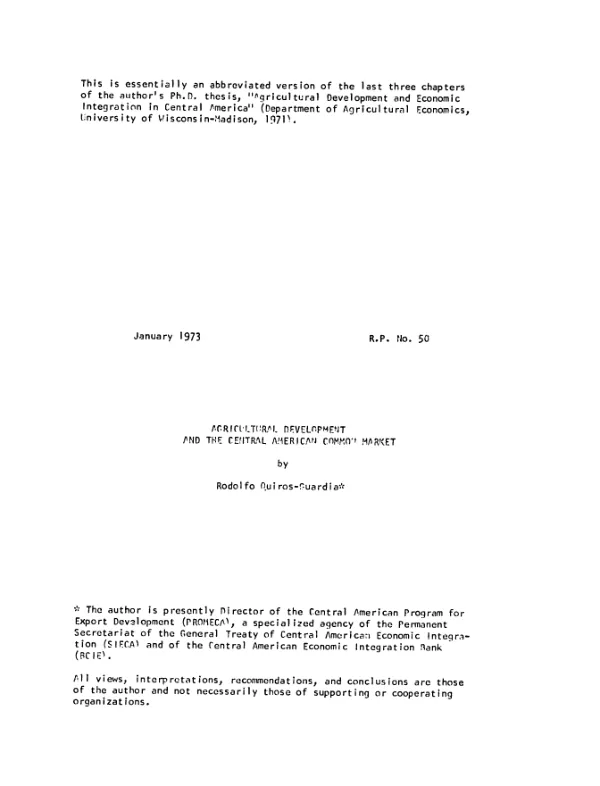
Agricultural development and the Central American common market
The Central American Common Market, including Honduras, Costa Rica, Guatemala, El Salvador, and Nicaragua, was established by treaties in 1959-60.
Quiros-Guardia, Rodolfo · 1970
Sign in to readA free account is required to download.
Abstract
The common market stage of economic integration has virtually been achieved; its immediate objective is formation of a customs union and achievement of free factor movements and its longer term objective is formation of an economic union among the five member nations. Economic integration is only a means to achieve economic development through acceleration of economic growth and the transformation of production and trade patterns. Regional integration is not a necessary condition for agricultural development, but it may expand the market for agricultural products, leading to stability, productivity gains, and economic growth in agriculture. Free trade should encourage greater regional specialization and production efficiency. Regional integration of research and training can lead to improved agricultural economy. A unified policy could enhance the bargaining power of the Central American nations as long as the major export crops remain competitive in international markets. Since agricultural exports provide 95percent of total foreign earnings, agriculture plays a significant role in maintaining internal growth and balance of payments stability within the Common Market.
Connected topics