USAID. MISSION TO SRI LANKA
Agricultural education development
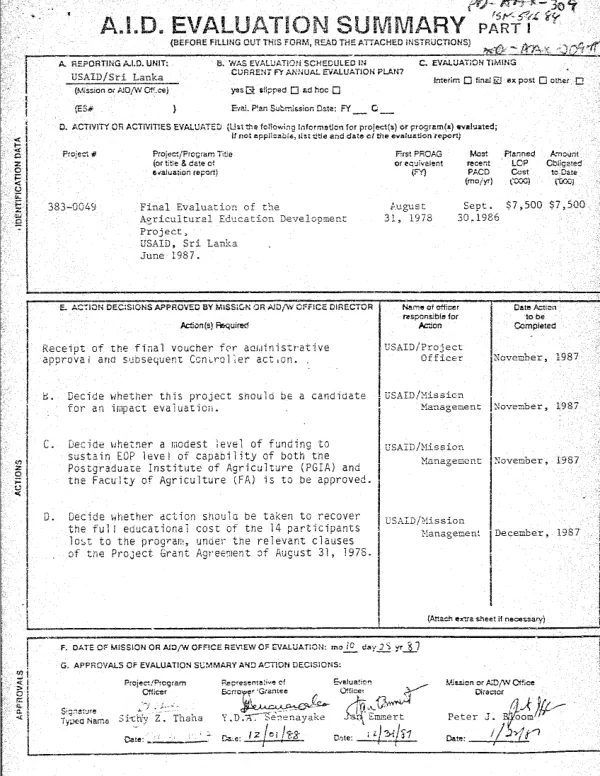
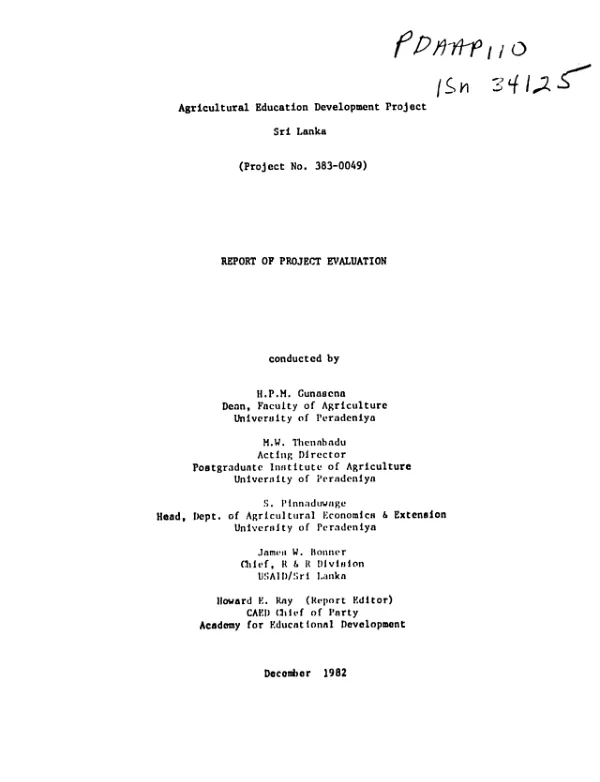
Evaluates project to increase the capacity of Sri Lankan universities to train agricultural manpower.
Littlefield, Sarah J. · 1983
Sign in to readA free account is required to download.
Abstract
PES covers the period 8/78-9/82 and is based on document review, site visits, and questionnaires administered to recipients and providers of project TA and training. Progress has generally been satisfactory. The target of 38 junior faculty from the Faculty of Agriculture (FA) of The Post Graduate Institute of Agriculture (PGIA) to receive U.S., Ph.D. training has been reduced to 36 Ph.D."s and one M.S. due to the inability of two trainees to complete the Ph.D. As of 12/82, three candidates have obtained the Ph.D., 34 others are working towards it (one at PGIA), and one is working on the M.Sc. To allow completion of Ph.D. training, the project completion date is being extended from 9/85 to 12/86. Despite initial delays, 90% of teaching and research equipment has been either processed for shipment or received. Library equipment has also been purchased, although only 30% of the new acquisitions targeted has been purchased. TA has been provided in developing guidance for in-country Ph.D. research and in creating 30 new sets of course outlines and lecture notes. Due to a Government of Sri Lanka (GOSL) policy change regarding undergraduate training, two new FA"s have been established and a third is planned. Construction of new facilities at the PGIA, which remains the only Sri Lankan institution offering post-graduate study, is only 40% complete due to a GOSL budgetary austerity program begun in 1980 (and exacerbated by unexpectedly high inflation); completion is set for 1986, a reasonable date given the unrealistic Project Paper target. GOSL budgetary constraints may also lead by the project"s end to a 4-5% reduction in the PGIA"s total academic staff. The three FA"s combined should produce 180 B.Sc. graduates annually by 1985-86 and the project target of 200 about 2 years later; the delay is due to the construction delays at PGIA. The target of tripling the annual number of in-country postgraduates should be reached on schedule. The project highlights the importance of using quantitative targets to assess a project"s progress and the need to avoid depopulating departments of essential staff through personnel training programs.