USAID DEC
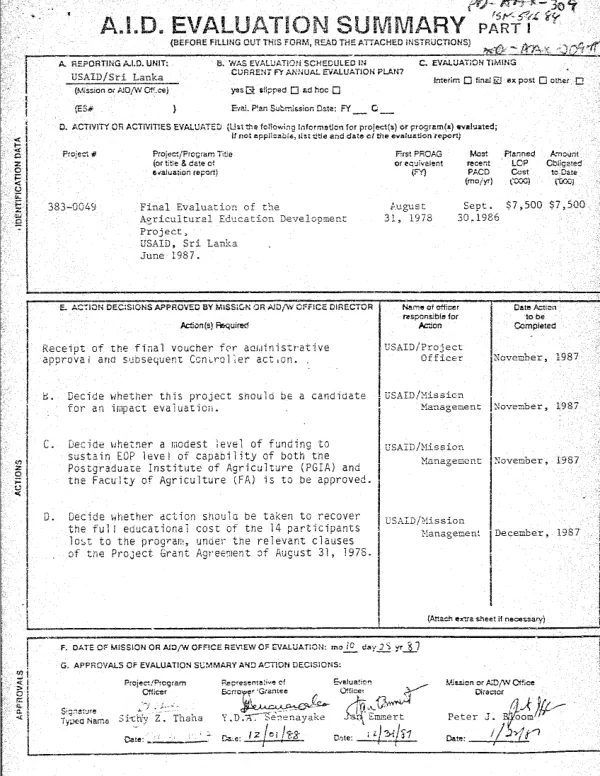
Final evaluation of the agricultural education development project, USAID, Sri Lanka, June 1987
Sign inUSAID. MISSION TO SRI LANKA
Final evaluation of the agricultural education development project, USAID, Sri Lanka, June 1987
Summarizes final external evaluation (XD-AAX-309-A) of a project to strengthen Sri Lanka"s Postgraduate Institute of Agriculture (PGIA) and the Faculty of Agriculture (FA) of the University of Peradeniya.
1988
Sign in to readA free account is required to download.
Abstract
Evaluation covered 8/78-6/87 and was based on document review and interviews with PGIA, FA, USAID/SL, and project personnel and with returned participants. The project design had a sound mix of inputs and outputs, and the project was implemented well. Inputs included: training of 39 junior faculty (23 Ph.D., 2 M.Sc., and 14 lost to the program); short, nondegree technical training of 5 staff; long- and short-term TA; and procurement of books, periodicals, microfiche volumes, and equipment. The project did, as planned, vastly increase the capability of the PGIA and the FA to do research and train postgraduates, as well as undergraduates. However, the project"s objective of tripling the numbers of postgraduate degrees granted before faculty returned from training abroad was unrealistic. The project"s largest problem was that 14 participants did not return to their faculty posts after training, due to the ethnic conflict that erupted while they were abroad. Also, three budgetary problems will affect project sustainability: lack of research funding; inadequate funds for maintainance of library and scientific equipment; and poor salaries paid to the FA staff. The following lessons were noted: (1) it is important to carefully estimate the time required to develop institutional capacity before quantifying a schedule of institutional outputs; (2) projects that involve much Ph.D. training and institution building should be at least 10 years long; (3) training participants in one discipline at several universities can strengthen academic departments; (4) permitting participants to purchase equipment from their research allowance made computers available to the institution; and (5) low-cost technician training resulted in effective use of scientific equipment. Recommendations are to: conduct an impact evaluation after 5 years to determine PGIA"s and FA"s institutional contributions, problems, and needs; support further strengthening of PGIA and FA to ensure that the indigenous capacity to train M.Phil"s and Ph.D."s continues to develop and and that the FA continues to do quality research and teaching; help FA to further develop its relationships with Pennsylvania State University, Virginia Polytechnic Institute and State University, and Texas A&M University; include technician training in all projects that provide scientific equipment; to reduce participant attrition, provide only subject matter training in the U.S. for postgraduate students and support their thesis research in Sri Lanka, with the degree granted by the University of Peradeniya. (Author abstract, modified)