USAID DEC
Agricultural inputs support I -- agricultural inputs support II -- structural adjustment support
Sign inUSAID. MISSION TO ZAIRE
Agricultural inputs support I -- agricultural inputs support II -- structural adjustment support
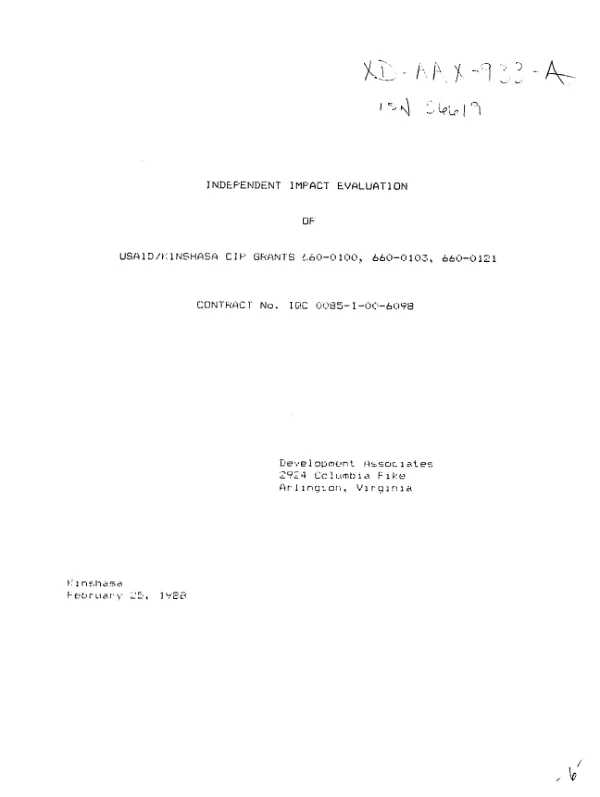
Summarizes attached evaluation of three commodity import programs (CIP"s) in Zaire implemented through private agro-related firms and designed to benefit low-resource farmers, consumers, and wage earners.
Johnson, Vernon; Mueller, Manfred +1 more · 1988
Sign in to readA free account is required to download.
Abstract
Final evaluation covers activities in 1987 and is based on document review and interviews with USAID/Z and GOZ officials and managers of private importing firms. The overall economic impact of the CIP"s has been mixed. Macro indicators (e.g., balance of payments) largely have not been affected by the programs, but impact on the selected private importing firms implementing the CIP"s has been substantial - instead of facing a possible shut down, some firms have actually increased employment (and wages). Impact on small farmers and the rural subsector was difficult to assess; the most significant benefits result from the improved roads, dependable farm-to-market transport, and inputs such as livestock feed and fertilizer made possible by the CIP"s. Farmers also benefited from the use of local currency generated by the CIP"s to support USAID/Z agricultural projects. Taken alone, the CIP"s have had only marginal influence on GOZ policy reform, but when linked with International Monetary Fund and World Bank conditionalities, their impact has been considerable. Farmgate prices have generally increased, and when higher prices are linked with better farm-to-market transport and localized technical assistance, agricultural production increases as well. All in all, useful policy reforms are being carried out, but the constant monitoring required to verify progress raises questions about the number of conditions that can be imposed in a given period of time. This also points up the need to develop a method for measuring price changes and production over time at the micro level. Another lesson is that CIP"s are useful in that they are able to engage the private sector in priority areas of development without the need for discrete projects. Finally, a review of CIP management practices showed dramatic improvements over previous evaluations, although the end use of imported commodities continues to be insufficiently monitored. Recommendations are made to improve end use monitoring, require private firms applying for CIP financing to provide a statement of probable impact of the program on employment and production, and improve monitoring of GOZ progress in industrial and agricultural price controls, control procedures for commodity exports, and the effects of lowered tariffs on formerly protected firms.