USAID DEC
Dominica structural adjustment program I, II -- Grenada structural adjustment program -- PMPP policy reform component
Sign inUSAID. BUR. FOR LATIN AMERICA AND THE CARIBBEAN. REGIONAL DEVELOPMENT OFC.
Dominica structural adjustment program I, II -- Grenada structural adjustment program -- PMPP policy reform component
Summarizes final evaluation (PN-AAX-231) of policy reform programs in Dominica and Grenada in support of improved public management/policy planning and structural adjustment.
1990
Sign in to readA free account is required to download.
Abstract
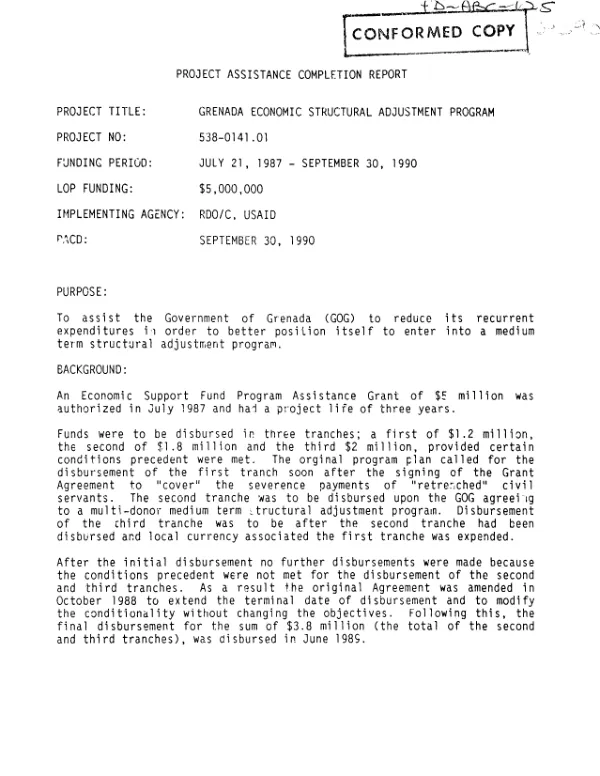
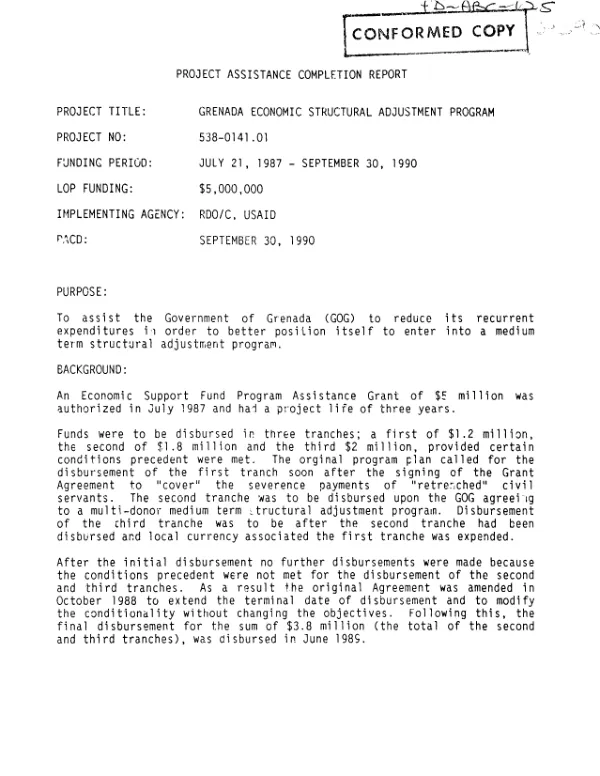
The evaluation covered the period FY87-1/90. A.I.D. used different programming methods in the two countries: in Dominica it focused on improving an existing system, whereas in Grenada it substituted new and drastically different policies. Although policy reform achievements varied in Grenada and Dominica, both countries reduced their fiscal deficits and experienced strong economic growth. In Grenada, various tax reforms were implemented, among them the introduction of a Value Added Tax (VAT). These reforms did raise revenues, but they failed to realize their full economic potential, mainly because their implementation was too rapid for such a drastic change. The program failed to realize that the Government lacked the capacity to administer the old taxes, much less institute new ones. There was no phase-in or training period, business recordkeeping was inadequate, and continual changes in VAT implementation created uncertainty among private enterprises. Moreover, although levels of income and welfare increased for all income levels, they increased much more for higher income individuals and corporations than for those in lower income groups. Other reforms in Grenada aimed at improving civil service efficiency. The drastic retrenchment plan carried out, however, did not have the desired effect. Instead, the more skilled and senior personnel departed, requiring expensive severance payments. As a result, Government operations suffered. In Dominica, training, TA, and computers provided under the programs increased the administrative efficiency of the Customs and Inland Revenue Department. The programs also assisted in implementing a tax structure with fewer and lower rates, providing strong economic incentives and raising substantial revenues. The country experienced strong economic growth through increased exports and reduced domestic borrowing as well as increases in agricultural production and a boom in construction. Civil service reform efforts slightly reduced staff numbers, restricted public sector wage increases, and eliminated automatic wage increases. Numerous lessons were learned. (1) Creating new tax policies is not the solution to the problem of a weak tax institution. (2) The traditional VAT system is unlikely to succeed where tax administration is weak and proper records are unavailable. (3) Staff education and the mobilization of public support are as critical to a program"s success as is technical soundness. (4) A phased and sequential technique is better than a major overhaul of a tax system. (5) Improved performance could be achieved better through multi-donor rather than single donor support. (6) A.I.D. should not assume that developing countries share its view of the efficiency of the private sector. (7) When A.I.D. is a major donor, it should work to prevent the recipient country from developing a client-state mentality of dependence. (8) Short- term TA programs cannot be expected to satisfy long-term institution-building needs. It is necessary to introduce a civil service reform program to develop and maintain the skills of Government employees.