USAID. MISSION TO TUNISIA
Agricultural policy implementation project
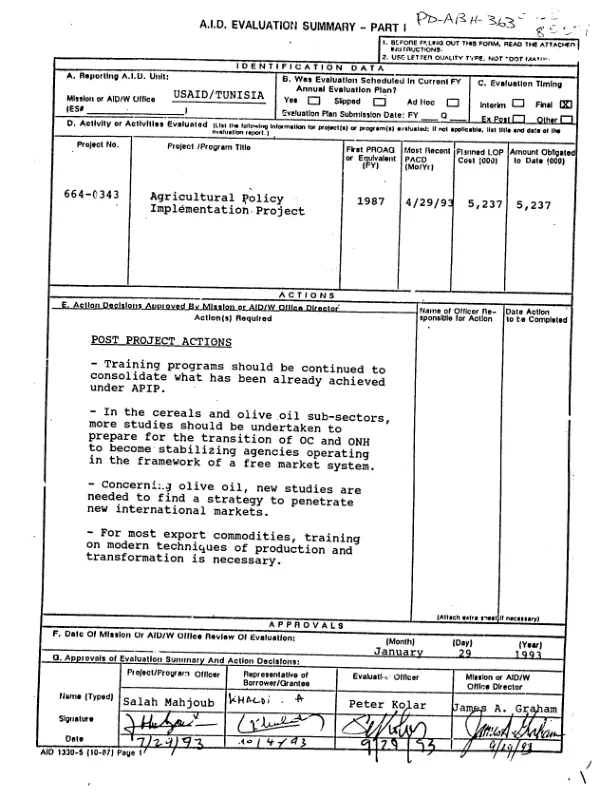
Summarizes final evaluation (PD-ABF-983) of a project (1987-4/93) to strengthen the Government of Tunisia"s (GOT) capacity to implement agricultural policy.
1993
Sign in to readA free account is required to download.
Abstract
The project largely achieved its two main objectives, namely, supporting GOT implementation of policy reforms and upgrading the technical capabilities of the Ministry of Agriculture"s Direction Generale de la Planification du Developpement et des Investissements Agricoles (DGPDIA). The project has produced more than 30 studies, generally of high quality, each with a set of recommendations and an action plan. The GOT has implemented many of the recommendations, and scheduled others for future implementation. In addition, project training has improved the DGPDIA"s capacity to analyze and monitor the impact of agricultural policies, and has created a positive attitude about a privatized agricultural sector in Tunisia. The project"s strongest contribution to policy reform has been a reduction in subsidies from the Compensation Fund from around 4% to 2% of the GDP. In addition, some important reforms have been undertaken in the cereal and oil subsectors to allow private operators to participate in collection, storage, distribution, and marketing; however, the private sector"s participation in practice is still limited. Policy recommendations in the export sector have generally not yet been implemented. In all of these sectors, however, the project has increased politicians" and decisionmakers" awareness of the need for reform. The project"s capacity building component was successful given the resource constraints involved. The project"s provision of just a few computers created a need for additional ones which was satisfied through other sources; the result was a general use of computers by DGPDIA staff, and increased productivity. Training programs increased the DGPDIA"s capacity for analysis to some extent, but suffered from three deficiencies: a selection process based on the availability rather than the qualifications of participants; a weak relationship between course content and participants" job requirements; and participants" time constraints, resulting in a high rate of absenteeism. Project management generally relied on informal procedures, with responsibility for progress reports and disseminating study results assigned to no particular party. More formal decisionmaking procedures would have resulted in greater efficiency.
Related documents