USAID DEC
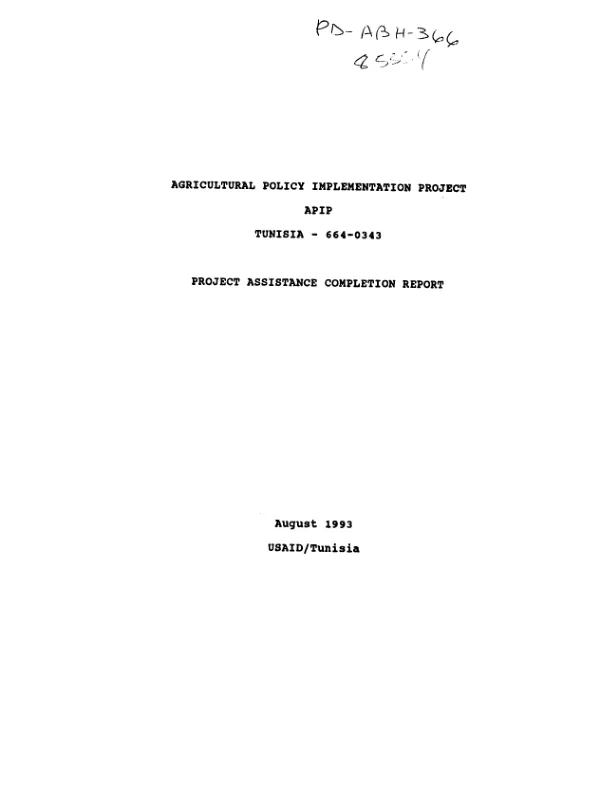
Agricultural policy implementation project (APIP), Tunisia, 664-0343 : project assistance completion report
Sign inUSAID. MISSION TO TUNISIA
Agricultural policy implementation project (APIP), Tunisia, 664-0343 : project assistance completion report
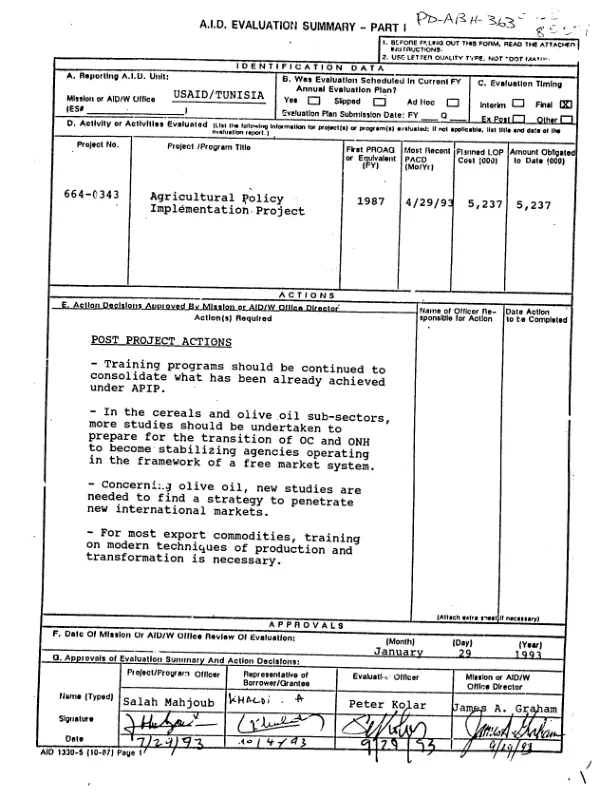
PACR of a project (4/89-4/93) to strengthen the Government of Tunisia's (GOT) capacity to conduct economic analyses, especially those needed to support the GOT/World Bank Agricultural Structural Adjustment Program (ASAP).
1993
Sign in to readA free account is required to download.
Abstract
The project succeeded in readying the Tunisian economic environment for an agribusiness focus. Through formal and on-the-job training, it increased the capability of GOT personnel to conduct policy analyses, and through policy dialogue, it has changed attitudes toward private sector participation in policy decisions and development within the agricultural (and other) sectors. The project conducted more than 35 TA assignments with contractors, the GOT, and numerous public and private sector institutions. Its major accomplishments were in the areas of policy reform, training, study tours to the United States and other countries, use of mathematical tools to analyze policy impacts, and institutional development. Highlights include: (1) policy reform in cereals assembly, storage, and marketing; (2) assistance in setting up a grain grading system; (3) demonstrations and training for the Director of Agricultural Statistics on methods of improving crop forecasting; (4) liberalization of imports of powdered milk and animal feed, and of exports of edible oils, olive oil, and wine; (5) reduction or elimination of subsidies on agricultural inputs, irrigation water, grain transportation, and a number of basic food prices; (6) seminars on structural adjustment and policy reform and roundtables on specific commodities such as cereal and flowers; and (7) institutional development in such areas as project management, contracting procedures, financial management, drafting scopes of work, and reporting. Lessons learned include the following. (1) An interministerial coordinating committee is vital in getting consensus on priorities, making decisions about implementation, and disseminating information about project activities and results. Committee members should be high enough to represent their agencies, but not so high as to be too busy to attend meetings. (2) Participation by host country experts is essential; subcontracting with local consultants is one way to ensure participation, but unfortunately does not increase host government capacity. (3) At the earliest possible date, the project should use local experts to assess procurement needs, and if appropriate, make the prime contractor responsible for procurement. (4) The project should maintain flexibility in implementation, but should try to stick to a yearly plan so that TA can be planned in advance. (5) Host country contracting procedures should be thoroughly reviewed to avoid unforeseen problems; in this project, a misunderstanding on payment held up one contract more than a year. On the other hand, direct USAID contracts can be very time-consuming, so contracts under $25,000 should not require formal bidding. (6) A variety of information dissemination mechanisms (brochures, newsletters, roundtables, seminars, etc.) proved helpful in this project; the host country organization should institutionalize these activities. (7) The project's seminars were very well-attended by the public and private sectors, generated a lot of discussion, and resulted in proposals and actions for policy reform.
![Final evaluation of the Tunisia agricultural policiy [i.e. policy] implementation project (APIP) no. 664-0343](https://covers.devme.ai/gen/8003.webp)
![Final evaluation of the Tunisia agricultural policiy [i.e. policy] implementation project (APIP) no. 664-0343](https://covers.devme.ai/gen/67284.webp)