USAID DEC
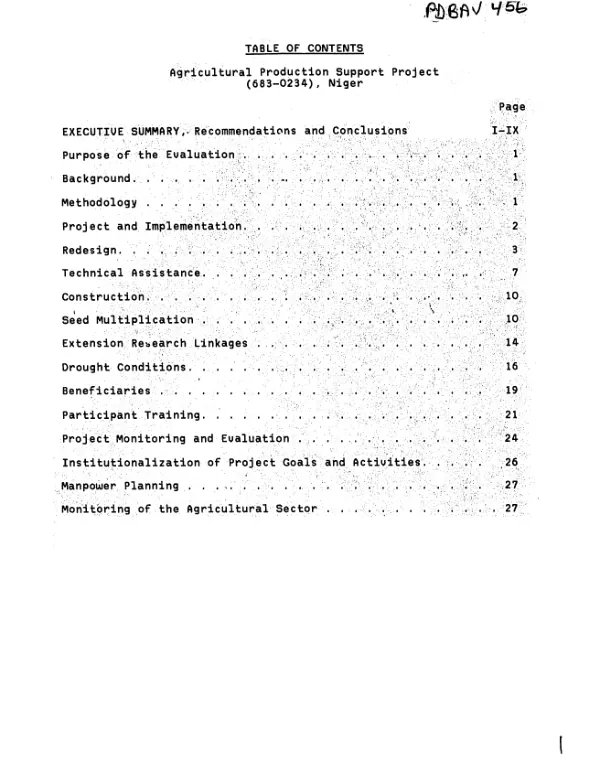
Agricultural production support project (683-0234) : in - house evaluation Nov./Dec. 1984
Sign inUSAID. MISSION TO NIGER
Agricultural production support project (683-0234) : in - house evaluation Nov./Dec. 1984
Evaluates project to increase agricultural production in Niger by expanding and improving national-level support services.
1983
Sign in to readA free account is required to download.
Abstract
In-house evaluation covers the period 8/82-12/84 and is based on document review and interviews with Government of Niger (GON) and A.I.D. officials. Implementation has been delayed for over a year. Retarding factors have included the time needed by the GON to meet the Conditions Precedent and delays in procuring TA through an educational institution. The major factor, however, was a 1982 shift in GON strategy and policy to stress increased participation by cooperatives in rural development, agricultural management, and the distribution of agricultural inputs and credit, as well as increased participation by the private sector in the provision of inputs and credit. This new GON strategy led to a redesign of the project's input supply and cooperative training components; the redesign eliminated construction and equipping of a warehouse for the Centrale d'Approvisionnement (CA) and proposed the development of economically profitable cooperatives at all levels. The latter initiative includes establishing a Bank Guarantee Fund to serve cooperatives; local training at the cooperative level and later at higher levels; studies of agricultural machinery and animal traction and of the possibility of using indigenous phosphate deposits to reduce dependence on fertilizers from Nigeria; and a program to assist small enterprises with their production process. Nine recommendations are made in regard to the input supply and cooperative training components; chief among them is to transfer CA activities to the cooperatives. Also included are 28 other recommendations in regard to: (1) agricultural policy and planning (with a stress on generating reliable agricultural statistics); (2) linking of research and extension, currently a serious project shortcoming; (3) participant training (with a stress on the need to have remaining participants begin training in 1985); (4-5) overall and USAID project management; (6) the importance of including women in project activities; and (7) seed multiplication. It is noted that the GON has an emergency plan for collecting seed during the shortages expected in 1985.