USAID. MISSION TO GHANA
Agricultural productivity promotion program
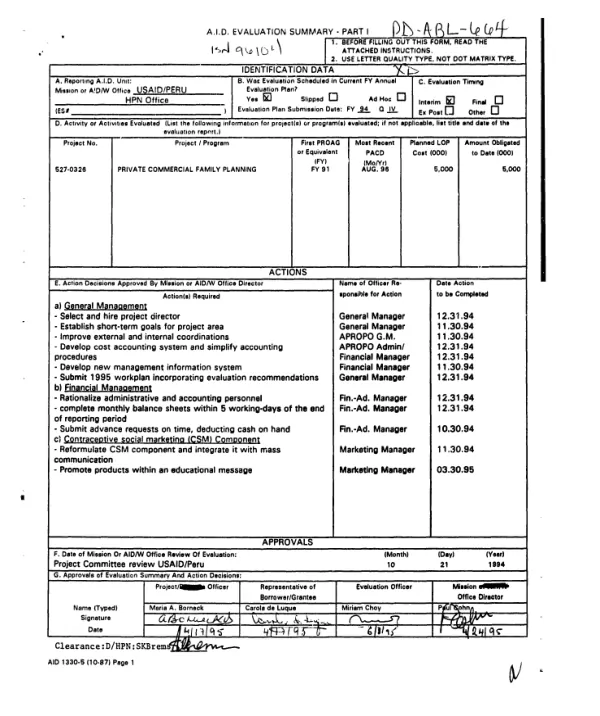
Summarizes mid-term evaluation (XD-ABD-602-A) of a program to provide a cash grant to the Government of Ghana (GOG) to support privatization of the seed and fertilizer industries, strengthen the extension service, rehabilitate feeder roads, and fund policy analyses and training.
1992
Sign in to readA free account is required to download.
Abstract
The evaluation covered the period FY88- 11/90. The program is making satisfactory progress. The GOG has met conditions relating to privatization of the seed and fertilizer industries and eliminated explicit fertilizer subsidies; the three tranches of dollars from the cash grant have been successfully released in auctions. However, while fertilizer subsidies were eliminated as planned, the combination of the loss of subsidy and the devaluation of the cedi caused a large increase in fertilizer price, which depressed sales and resulted in a large buildup in government-held fertilizer stock. This stock, plus the continuing GOG role in fertilizer sales, has retarded private sector activity. In the seed industry, the Ghana Seed Company was closed, but no private firms have stepped in to supply seed, which suggests that additional action is needed to provide the necessary enabling environment. Targets for feeder road rehabilitation will not be met because the roads were in worse shape than was thought, so the cost of rehabilitation per km has been higher than expected. Nonetheless, the program has significantly improved farmers" access to markets and services. The extension service has increased its mobility, outreach capacity, and training of field workers (although the service needs access to research if it is going to have truly valuable information to give the farmers). The women"s extension division is playing a notably important role in organizing rural women to benefit from the resources provided and in improving living conditions of rural families. Three studies were conducted: an analysis of the need for food aid and the impact on domestic food production and consumption; a comparison of alternative extension programs; and an economic analysis of fertilizer use and consumption. Per capita output and yield have increased modestly during the period of the program. However, it is impossible to attribute these results directly to the program because of weaknesses in the monitoring, evaluation, and impact assessment systems. Several lessons were learned. (1) Joint program design with GOG staff at all stages has generated trust between USAID/G and GOG officials and facilitated implementation and problem solving. (2) Missions could meet Development Fund for Africa (DFA) requirements for monitoring and evaluation if provided with the necessary human and capital resources. The Mission should negotiate performance criteria to satisfy DFA requirements. (3) The perception that program assistance is less management- intensive than project assistance was false in this case. (4) Baseline data should be collected and impact assessment framework completed simultaneously with program design. (5) Privatization is a long-term process requiring careful nurturing to build public and government confidence.
Related documents
Documents in this collection
 1991
1991USAID DEC
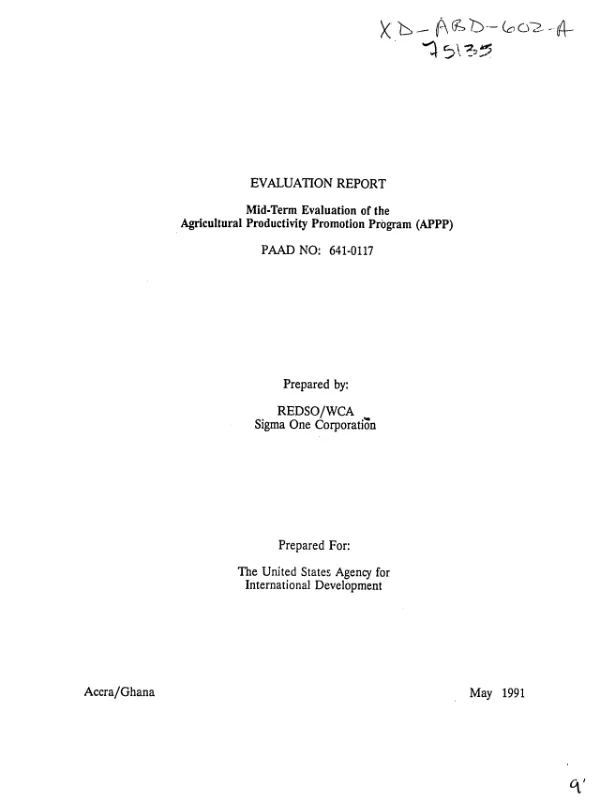
Evaluation report : mid-term evaluation of the agricultural productivity promotion program (APPP)
Open record 1993
1993USAID DEC