USAID. MISSION TO GHANA
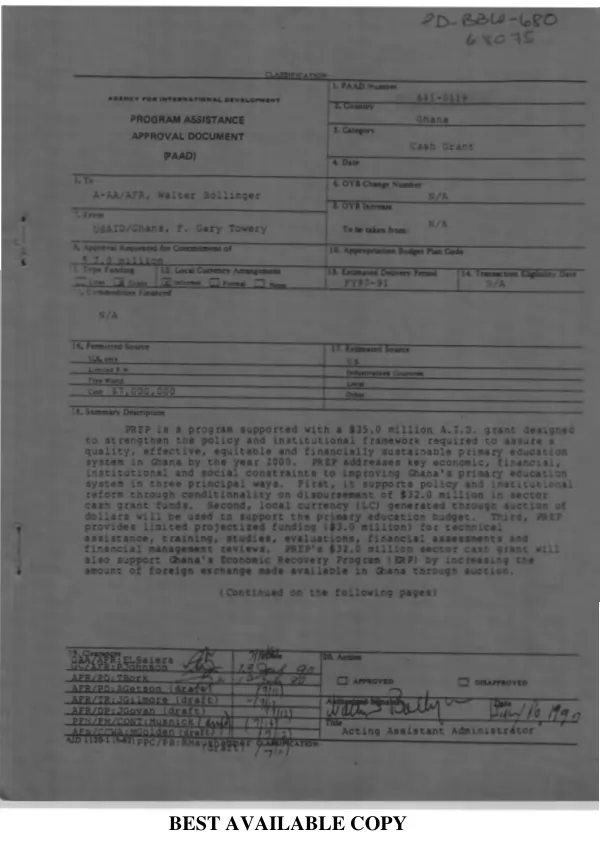
Primary education program (PREP) -- primary education project (PREP)
Summarizes a mid-term evaluation (PD-ABI-547) of a program/project to strengthen the policy and institutional frameworks required to improve the quality, accessibility, equity, and financial sustainability of Ghana"s primary education system by the year 2000 (PREP program).
1995
Sign in to readA free account is required to download.
Abstract
The evaluation covered the period 9/90-9/93. With one exception, conditionalities for the first four tranches have been met, and PREP has had considerable impact on stimulating education reform by providing inputs (textbook production and distribution, teacher training) and encouraging policy reform (decentralization, equity improvement) in the primary education sector. The one exception is that the Government has not yet actually implemented a policy to improve equity. Specific findings included the following. (1) The Ministry of Education significantly overstated its primary education budget; also, the revolving book fund is in arrears. (2) The teacher force has grown by 4,000 to 66,000, but 26% are not trained as teachers, and teachers are not motivated to teach, since the profession is held in low esteem and salaries are low. In-service teaching is poorly planned, and linkages between pre-service and in-service training are weak. (3) Equity pilots have been useful for generally improving target schools but have not led to specific plans to attract or retain more students, especially females. (4) PREP"s textbook distribution system, taken over from earlier World Bank and UNDP projects, is experiencing a backlog of unfilled printing orders. Moreover, there is evidence that many books, once printed and delivered to the MOE, are not getting to schools and when they do, they are not used. (5) The poor results obtained via criterion referenced testing (CRT) in 1992 and 1993 have generated discussion of curriculum reform -- reducing the number of subjects taught, increasing school hours, and revising textbooks. (6) Analysis of annual education census data is 2 years behind schedule. Overall, success to date bodes well for the future, but there is need for further policy dialogue and for revision of conditionalities. The existing conditionalities constitute necessary are not sufficient to sustain educational development in Ghana, as is evident from the fact that PREP has had little impact on improved teaching and learning or on improved management at the district and school level. Lessons learned include the following. (1) While PREP is strengthening policy and institutional frameworks in the primary education system, these improvements are not strong enough to produce significant changes in CRT scores. Expectations and goals need to be scaled back. (2) Leveraging reform by conditionality is not the only strategy for educational reform. Evaluative capacity must also be strengthened in order to serve as a foundation for making informed policy decisions.