USAID. MISSION TO LIBERIA
Agricultural research and extension (669-0135) : second evaluation
Evaluates project to strengthen the research and extension capabilities of Liberia's Central Agricultural Research Institute (CARI).
Richards, Freddie|Everson, Everett · 1983
Sign in to readA free account is required to download.
Abstract
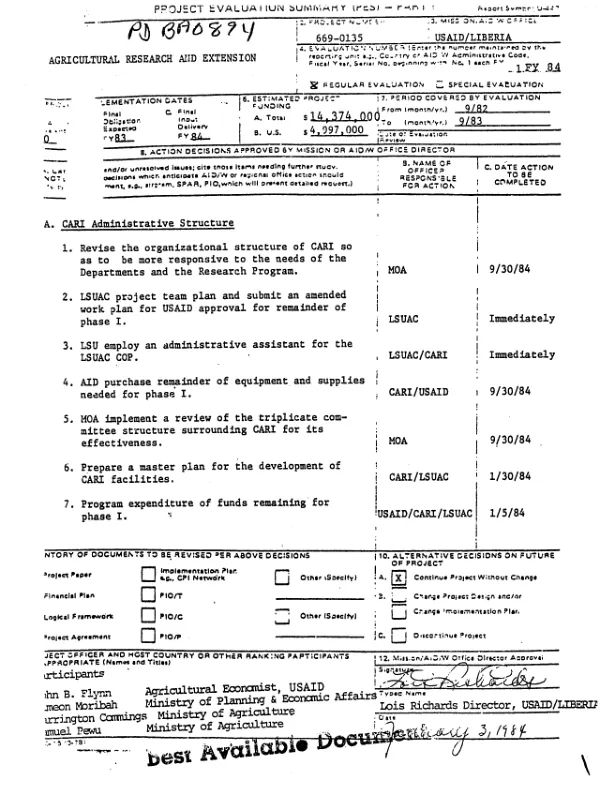
Special evaluation covers the period 9/82-9/83 and is based on document review, site visits, interviews with CARI research, administrative, and TA staff, and meetings with representatives of related institutions. Despite initial delays in recruiting a TA team, the team's difficulty in procuring needed equipment, and serious communication problems, CARI is becoming a viable institution. An administrative structure is being built up; several Liberians are now key researchers, and returned participants (289 person-months in the United States) will clearly help the understaffed program. With government financial support and implementation of this evaluation's recommendations, most project objectives should be achieved. The project suffers from general organizational problems, including slow delivery of government research funds, personnel problems, and slow progress in developing laboratory and extension and agricultural engineering support facilities. Poor cooperation has hindered formation of an overall, multidisciplinary research strategy. Research itself has been hampered by poor security in field plots and by inadequate facilities and equipment. While excellent research has been done at the Suakoko branch station, current off-station testing is poorly organized. Despite project training and significant progress in crop science under three prior donor projects, applied research is very weak in a large number of fields and Liberians are needed for the plant pathology, entomology, and animal science programs. While CARI has developed excellent linkages with international research centers, its almost complete lack of linkages with country extension entities seriously threatens its mission to feed Liberia; Phase II must effect dramatic changes in this area. Recommendations include reorganizing CARI into two divisions (Research Coordination and Extension Liaison); placing seed multiplication and plant and fish propagation activities in the Extension Liaison to permit contacts with county agricultural development projects and extension entities; and boldly pursuing linkages with other Liberian research institutions during Phase II.