USAID. MISSION TO INDIA
Agricultural research project
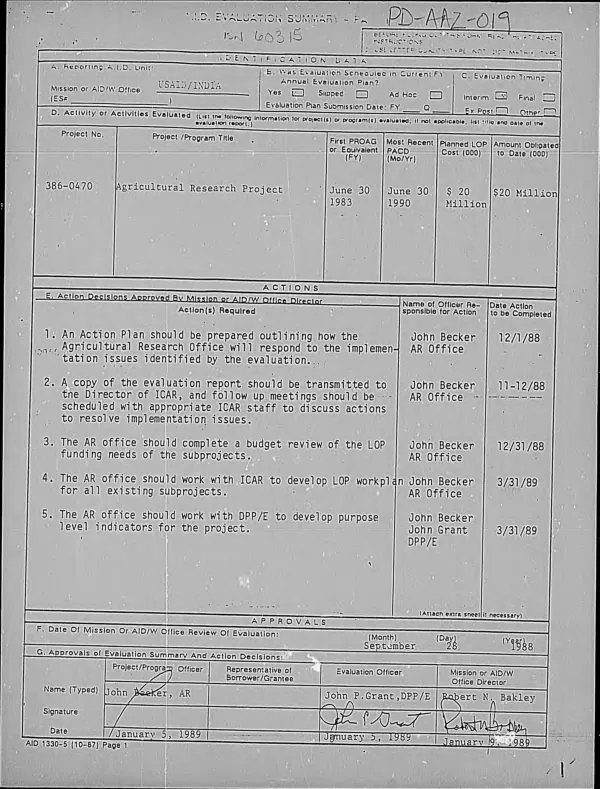
Summarizes interim evaluation (PD-AAX-976) of a project to strengthen Indian agricultural research capacity.
1989
Sign in to readA free account is required to download.
Abstract
The evaluation was conducted after 4 years of a 9-year project. The original project design and concept are sound, particularly the objective to re-establishment a cooperative agricultural science relationship between the U.S. and India after a 10-year hiatus. One significant problem, however, has been the understaffing and ineffectiveness of the Project Implementation Unit (PIU); there have also been some problems in implementing subprojects (SP"s). On the other hand, training programs and equipment have been of high quality, if delayed, and most project objectives are attainable by PACD if there is improvement in the performance of the PIU (or alternative body), and a reallocation of funding among SP"s. Other key findings are as follows. (1) The project has the potential to build a long-term collaborative relationship if the effort is sustained. (2) Prospects for postproject sustainability are good, largely because SP"s are already included in the Indian Council on Agricultural Research"s (ICAR) plans. (3) A follow-up of this project, or a similar umbrella-type project, could be a significant component of future strategy for Indo-U.S. collaboration in agricultural research, but not the exclusive approach. (4) In certain fields, larger stand-alone projects are already evolving, which provide the basis for longer-term benefits and more truly collaborative research than was possible at the early stages of this project"s SP"s. (5) Project experience should help to identify a list of topics with a sharper focus, which can make a lasting contribution and build scientist-to-scientist and institution-to institution collaborative research. (6) It is realistic to plan for long-range Indo-U.S. cooperative research programs in a few selected areas. However, this plan will require a financial commitment on both sides for a minimum of 10 to 15 years. Key recommendations are to: (1) ensure that ICAR bring the PIU into more effective operation or implement an acceptable alternative; (2) agree on actions to improve SP implementation and develop workplans for all SP"s; and (3) review the financial needs of the SP"s and reallocate budgets. Lessons learned are: (1) Umbrella projects, which involve the design, review, and approval of multiple SP"s require more start up time than other kinds of projects. (2) The flexibility of an umbrella design does not reduce the need for thorough SP analysis. (3) Simplification of design and implementation procedures and realistic projections would have improved project performance. (4) For effective implementation of complex umbrella projects of this kind, there is a need for efficient project coordination and support units in both USAID/I and the GOI. See also abstract of PD-AAX-976. (Author abstract, modified)