USAID. BUR. FOR AFRICA
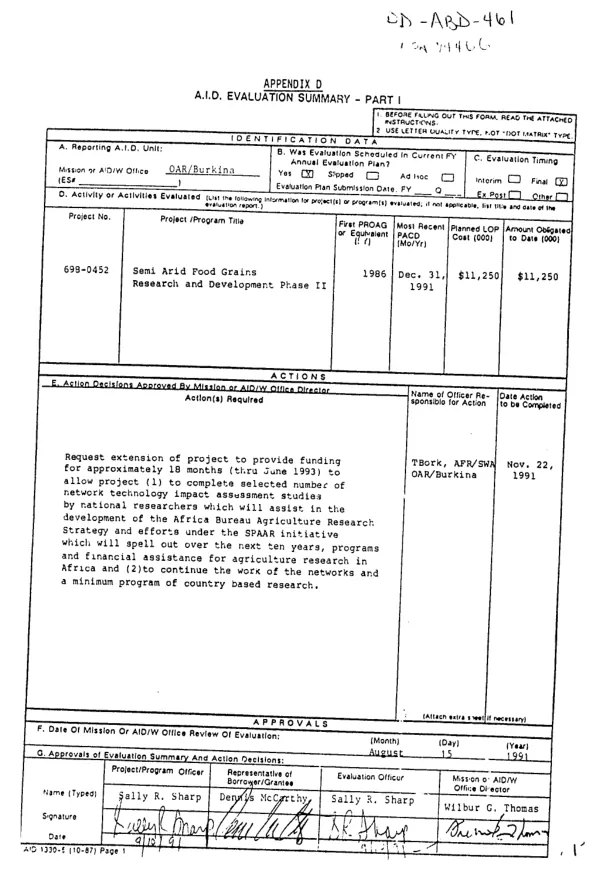
Semi-arid food grains research and development, phase II
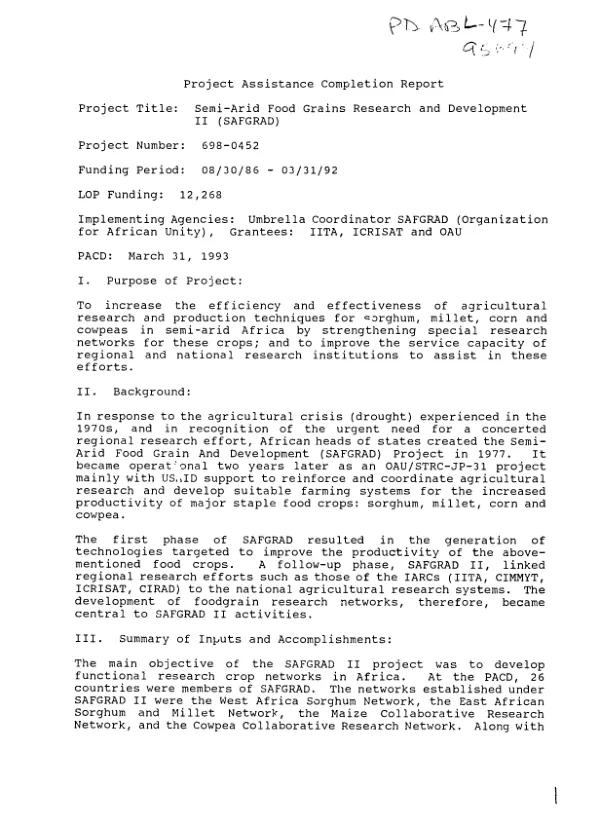
Summarizes final evaluation of a project to strengthen a regional collaborative crop network system for major semi-arid food grains research in sub-Saharan Africa.
1991
Sign in to readA free account is required to download.
Abstract
The network system operates under the auspices of the Organization of African Unity (OAU). The evaluation covered the period FY86-7/91. All inputs were supplied and the project was successful. Twenty- six African states participated in four crop networks -- the West and Central Africa Maize Network (WECAMAN); the West and Central Africa Cowpea Research Network (RENACO); the West and Central Africa Sorghum Research network (WCASRN); and the East Africa Regional Sorghum and Millet Network (EARSAM). A.I.D. has provided over 20 years of support to this project and its predecessors, representing a significant and singular commitment to an Africa-centered organization for agricultural research. National agricultural research program scientists participated fully in setting the project"s research priorities, which emphasize major common biological constraints in semi-arid Africa. Network trials addressed production constraints on semi- arid agriculture through varietal improvement, and the regional coordination office assured that the research responded to national program interests and concerns. The networks also funded regionally oriented research by national programs and provided national scientists with a forum for scientific communication and exchange. Nearly 700 agricultural scientists and technicians participated in the program, and their professional development was achieved at a very low cost. This may be among the networks" most significant and lasting accomplishments. In collaboration with the international centers, the networks are an effective mechanism for pooling the research resources of both stronger and weaker national programs to address region-wide constraints on production. Technologies diffused by the networks are used in both on-station and on-farm trials. There is some evidence that technologies have been adopted by some farmers. Donor support is needed for the OAU"s regional coordination office to continue its effective support for the research networks. Several lessons were learned. (1) Agricultural research networking not only generates and diffuses improved technology, but also promotes the growth of a scientific community, overcoming language and political barriers and breaking down professional isolation. Exchange visits among scientists are especially effective. (2) Such networks benefit both strong and weak national programs. (3) Regional networks can be an effective mechanism for funding national research activities, but ways are needed to assure the adequate allocation of available financial resources to national programs. (4) The OAU is an appropriate organization and political framework within which to manage agricultural research networks. (5) Successful networks require an identified, shared problem, technical leadership from national scientists, collaboration among scientists and national support for regional research, an accepted regional coordinating body, and effective scientific supervision. (6) It will take a concerted effort to move beyond the varietal improvement approach to overcoming constraints on agricultural production in sub- Saharan Africa.
Related documents