USAID. BUR. FOR LATIN AMERICA AND THE CARIBBEAN. REGIONAL DEVELOPMENT OFC.
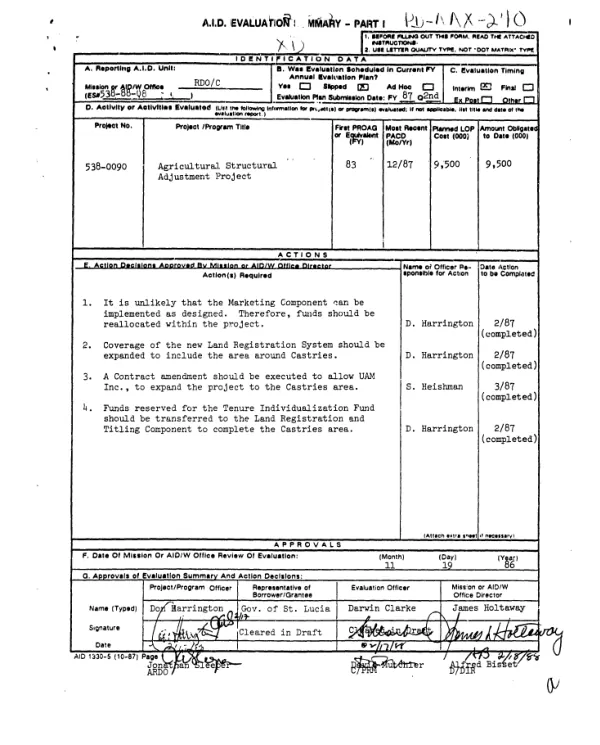
Agricultural structural adjustment project
Summarizes attached evaluation (XD-AAX-240-A) of a project to improve banana growing, diversify agriculture, and reform the land title system in St.
Harrington, Don; Clarke, Darwin · 1986
Sign in to readA free account is required to download.
Abstract
Lucia. Interim evaluation covered the period 1983-86, and was based on document review, site visits, and interviews with project and Mission staff, local officials, and members of the local private sector. The first component, banana rehabilitation, was modified to provide computer equipment to the Banana Growers" Association (BGA); this has contributed to reducing their administrative costs. Other planned inputs were deemed unnecessary as an improved market for bananas has motivated farmers to increase their replanting rates, input usage, and correct application of pesticides. Thus, the original purpose of the component has generally been accomplished. Similarly, the second component, marketing - which was to include seedling propagation and market promotion activities - has produced only one output - a marketing report, which although not yet endorsed by the government, will eventually lead to a sound marketing strategy. In the meantime, the country"s private agriculture marketing sector has improved markedly, so that other planned marketing promotion efforts are no longer needed or could not be accomplished before PACD. Plans to construct and renovate seedling propagation facilities are still thought to be an excellent investment, however, as farmer interest in new crops will probably pick up when the banana market becomes saturated. The final component, land surveying, adjudication, registration, and titling, addresses the major disincentive to agricultural investment: lack of clear title on some 45% of land parcels. The titling process, and the establishment of a well-functioning land registry will be completed on time and under budget. The proposed Tenure Individualization Fund (TIF) has been found to be unneeded, as there is sufficient liquidity within the private banking sector to satisfy the need for credit without project seed capital. Major recommendations are that all remaining funds be reassigned to land titling and that the Castries urban area be included in the titling process. While this evaluation did not specifically address lessons learned, RDO/C notes that a project of this nature is doomed to failure without widespread consensus and local political support, which this effort has enjoyed. Second, it is essential that there be definitive planning in terms of project operations: United Aerial Mapping, Inc., the contractor for the land titling component, has been outstanding in this regard. And, third, flexibility should be programmed into projects so that funds can be reprogrammed in response to external factors.
Related documents
Documents in this collection
 1986
1986USAID DEC
Interim evaluation of the St. Lucia agricultural structural adjustment project (538-0090) performed under work order no. 11 of technical support missions contract 0000-I-00-2023
Open record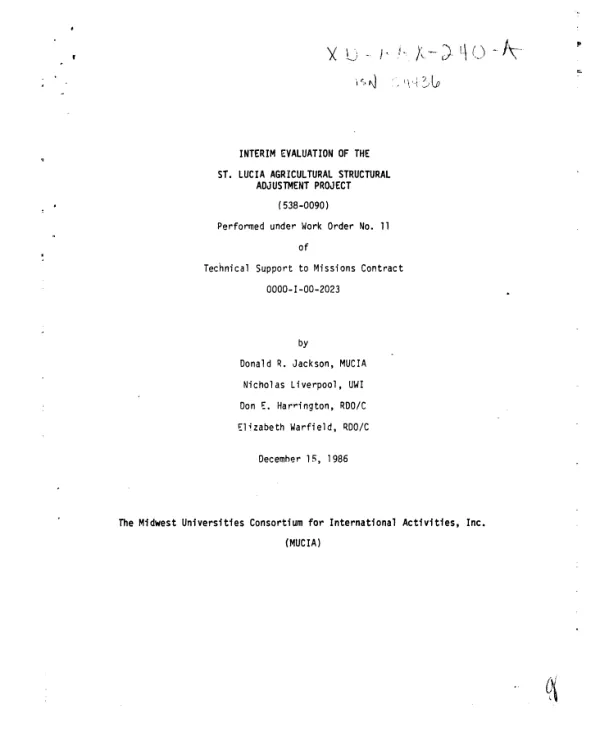 1986
1986USAID DEC
![Project assistance completion report [: agricultural structural adjustment project (538-0090)]](https://covers.devme.ai/gen/27792.webp)
![Project assistance completion report [: agricultural structural adjustment project (538-0090)]](https://covers.devme.ai/gen/9893.webp)