USAID DEC
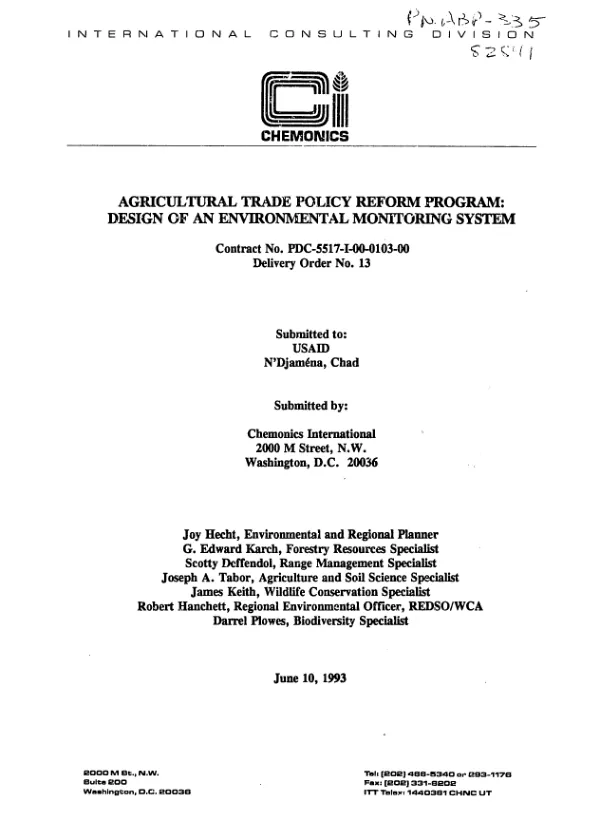
Agricultural trade policy reform program : design of an environmental monitoring system
Sign inCHEMONICS INTERNATIONAL, INC.
Agricultural trade policy reform program : design of an environmental monitoring system
USAID"s Agricultural Trade Policy Reform Program (ATPRP) in Chad is designed to increase the efficiency of Chad"s agricultural marketing system by encouraging tariff and regulatory reforms and helping traders and farmers take advantage of resulting opportunities.
Hecht, Joy; Karch, G. Edward · 1993
Sign in to readA free account is required to download.
Abstract
This report identifies ways in which the program may affect the environment, e.g., by introducing chemical fertilizers and pesticides, degrading vegetation, polluting critical water sources such as Lake Chad, and increasing deforestation. The report then considers five strategies for monitoring or mitigating these effects: (1) conventional ecological monitoring (which would identify environmental changes, but would not link them directly to ATPRP reforms); (2) targeted monitoring of villages and farmers most likely to be affected (which would address the causal link but would not show the full magnitude of the impacts); (3) focusing resources on mitigating environmental harms without attempting to monitor them; (4) dividing the monitoring effort into three independent, simultaneous steps, each corresponding to a causal link between ATPRP reforms and the environment; and (5) multi-step monitoring as in the previous suggestion, but extended over 10-15 years. The paper recommends the fourth strategy, preferring it to the fifth because of time constraints. A final section discusses issues pertinent to implementing the monitoring effort, e.g., what data should be collected and what are the staffing requirements. Five annexes consider in greater detail the implications of the ATPRP for specific elements of the environment: agronomy and soils; rangeland; forests; water; and wildlife.
Related documents
Documents in this collection
![Impact of trade liberalization on the Philippine economy : a CGE [computable general equilibrium] modeling approach](https://covers.devme.ai/gen/14535.webp) 1992
1992USAID DEC
Impact of trade liberalization on the Philippine economy : a CGE [computable general equilibrium] modeling approach
Open record![Final report : data base management programming support for SIMPAH [Sistema de Informacion de Mercados de Productos Agricolas de Honduras]](https://covers.devme.ai/gen/62880.webp) 1997
1997USAID DEC
![Report on the implementation by Mongolia of the WTO [World Trade Organization] valuation agreement](https://covers.devme.ai/gen/37570.webp)