USAID. BUR. FOR POLICY AND PROGRAM COORDINATION. CENTER FOR DEVELOPMENT INFORMATION AND EVALUATION (CDIE)
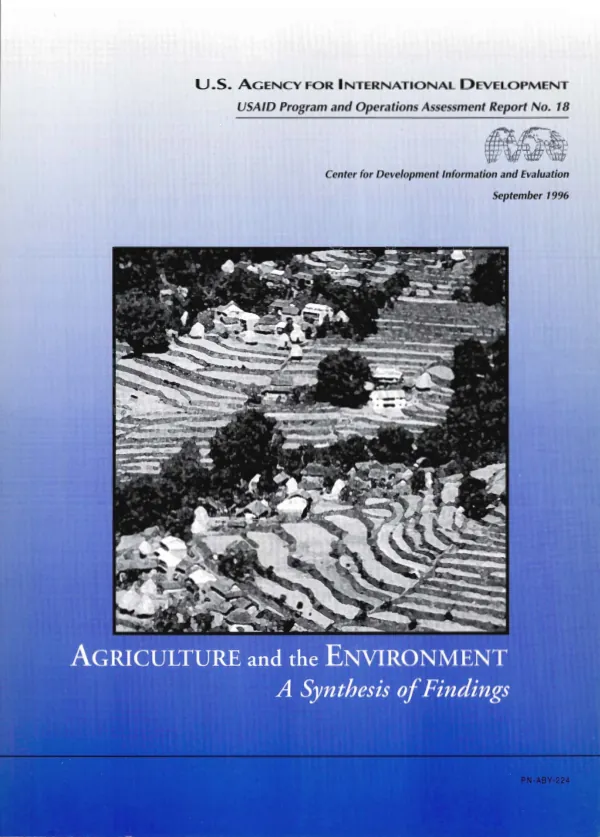
Agriculture and the environment : a synthesis of findings
This study assesses USAID"s activities in sustainable agriculture in The Gambia, Jamaica, Mali, Nepal, and the Philippines.
McClelland, Donald G. · 1996
Sign in to readA free account is required to download.
Abstract
In each country, USAID introduced specific conservation technologies designed not only to increase production, but to reduce soil erosion and improve watersheds. The study concludes that increased production need not be achieved at the expense of the environment; the two are complementary. All five USAID programs had positive socioeconomic and environmental impacts, but type and degree of impact varied by country. In The Gambia, saltwater barriers and water retention dams permitted uncultivable land to be brought into production, but contour plowing, grass waterways, and terraces were less successful. Jamaica"s program succeeded with a simple tree planting project, but a project to terrace steep hillsides using heavy equipment failed. Erosion barriers called rock lines proved successful in Mali. In Nepal, no single technology was widely adopted, but as a group the practices that were introduced noticeably increased yields and reduced erosion. In the Philippines, a method called sloping agricultural lands technology enables farmers to produce crops without damaging the natural resource base. Farmers took up the technologies not to avoid long-term soil erosion but to achieve short-term economic benefits. Environmental awareness campaigns did not seem to influence technology adoption, but the extent of local institutional and community involvement helps to explain why some programs were more successful than others. Appropriate economic policies were important in Mali and the Philippines, but in the other three countries the effects of economic policies on sustainable agriculture were neither positive nor negative. Although results varied, most programs yielded significant benefits. All countries experienced increased crop yields. Social benefits are exemplified in the Gambian village of Njawara, where the conservation infrastructure ended flooding. In Jamaica, the social security of participants improved, because coffee and cocoa trees provide an annual source of income over a period of 15-20 years. The environment benefited as well. In The Gambia, the conservation structures protected 15% of lowland rice-growing areas from salinization. In Mali, the rock lines resulted in decreased soil erosion and increased water retention. In Jamaica, tree planting combined with conservation infrastructure helped reduce soil losses on vulnerable hillsides. Participating areas in the Philippines saw increased terrace formation and soil stabilization. In Nepal, multipurpose trees and fodder grasses helped stabilize slopes, and use of organic fertilizer improved soil quality. All the technologies are replicable. The practices work well, are not complicated, and can be successfully extended to other areas with similar environmental problems and agroclimatic conditions. However, the institutional sustainability of these programs at the village level is questionable. The following management recommendations emerge. (1) Introduce conservation technologies that yield significant economic benefits relatively quickly, and that are easy to maintain and relatively inexpensive. (2) To help ensure sustainability, strengthen local organizations that supply inputs, technical advice, and markets. (3) Support soil and water conservation programs only when intended beneficiaries have secure access to land.