USAID DEC
Agriculture and the environment : farmers need simple technologies, secure tenure, fast payback
Sign inUSAID. BUR. FOR POLICY AND PROGRAM COORDINATION. CENTER FOR DEVELOPMENT INFORMATION AND EVALUATION (CDIE)
Agriculture and the environment : farmers need simple technologies, secure tenure, fast payback
Land degradation looms as a global problem.
McClelland, Donald · 1997
Sign in to readA free account is required to download.
Abstract
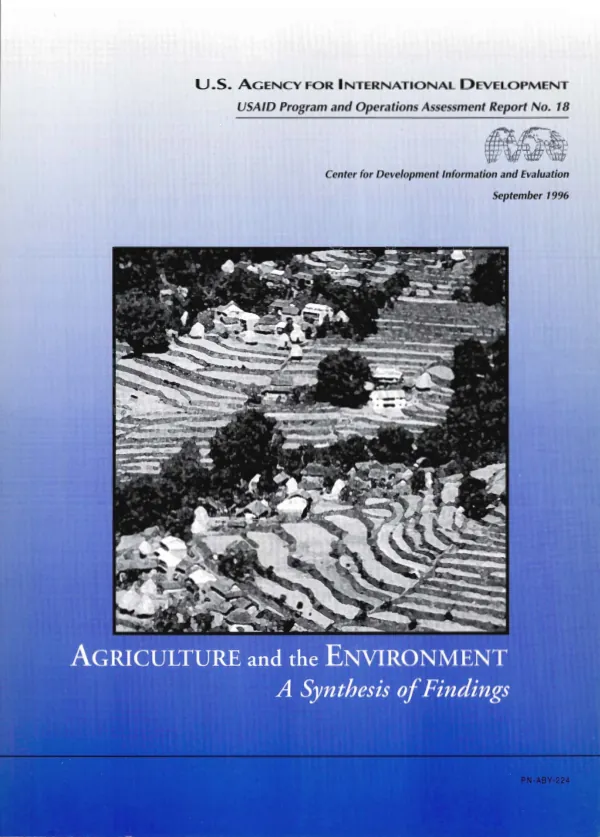
Between 1975 and the year 2000 the world will have lost 22% of its high-potential agricultural land, forcing farmers to expand onto lands which are less productive and more fragile. During the 1980s, USAID spent $645 million on sustainable agriculture programs that introduced appropriate conservation technologies aimed at increasing agricultural production and reducing soil erosion in developing countries. This report examines program efforts in five of these countries: The Gambia, Jamaica, Mali, Nepal, and the Philippines. In each country, the new technologies, which included terracing, tree-planting, and construction of erosion barriers, increased agricultural production, improved livelihoods and social security, prevented and reduced soil loss, and restored previously uncultivable land to farming. The technologies, which work well and are simple and easy to learn, can be successfully extended to other areas with similar environmental problems and agroclimatic conditions. However, improved technologies are of little lasting value without the institutions necessary to sustain and promote them. Therein lies the weak link in these programs. Inadequate institutions, particularly local ones, jeopardize the long-term sustainability of the farming practices introduced. This is an area USAID should target for improvement if the very real strides it has made in soil and water conservation are to continue into the next century. (Author abstract, modified)
Related documents