USAID. MISSION TO BANGLADESH
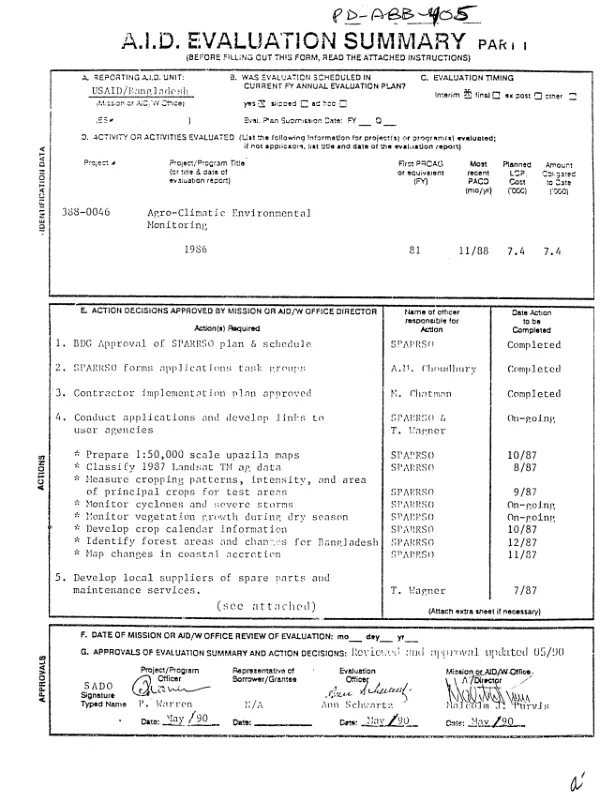
Agro-climatic/environmental and monitoring project
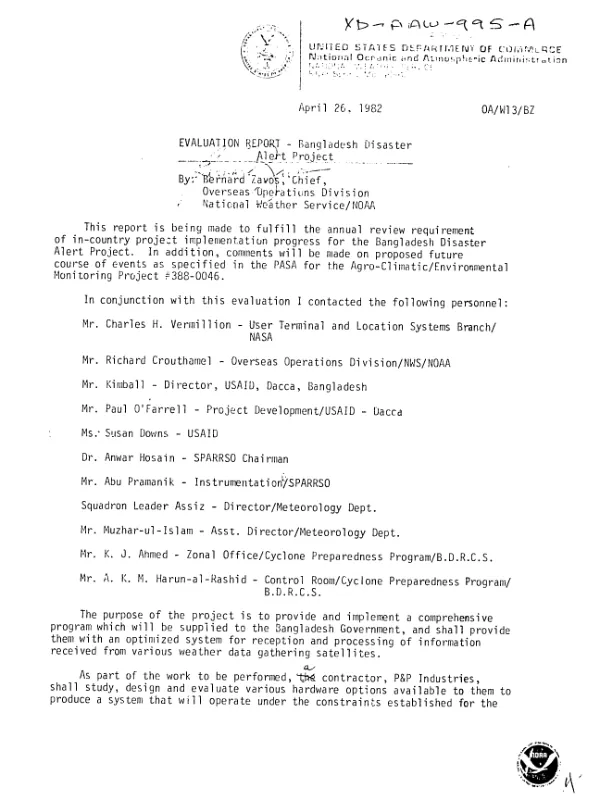
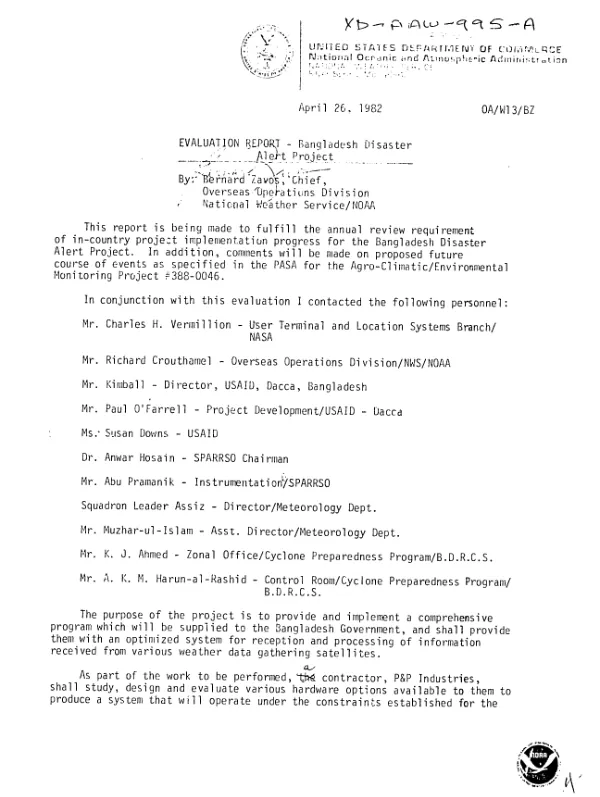
Summarizes attached annual evaluation (XD-AAW-995-A) of a project to improve the capacity of the Government of Bangladesh"s Space Research and Remote Sensing Organization (SPARRSO) to obtain, analyze, and disseminate agroclimatic data.
O"Farrell, Paul; Chaudhury, M. U. · 1970
Sign in to readA free account is required to download.
Abstract
Evaluation covered the period 1981-82 and was based on a site visit by an evaluation officer and end-of-tour reflections by the USAID Project Officer. Delays of 7-9 months in procuring equipment and of 5 months in training applications analysts make assessment of progress towards outputs difficult. However, the advanced meteorological ground station has been installed, and the Applications Center is about 95% complete and in use. There is an almost regular flow of satellite imagery to the Meteorological Department (SPARRSO"s main user agency) and SPARRSO has conducted studies of cropping patterns and forest surveys on a sample basis. Procurement delays were due to: (1) the very slow process (15 months) of transferring procurement funds and responsibility to the U.S. National Aeronautics Space Administration; (2) a concentration of efforts on implementing the centrally funded Disaster Alert Project (completed in 12/81), which contributed a large amount of the basic equipment to the present project; and (3) postponement of a planned visit by the SPARRSO Director to the United States to review future equipment procurement. The delay in applications training was mainly due to slowness in recruiting a long-term consultant. Since the educational background of SPARRSO ground station operators is less comprehensive than was first thought, operations and maintenance (O&M) training is being reoriented to develop the ability of the private sector - where salaries are sufficient to employ adequately trained personnel - to provide SPARRSO with O&M services. The need to shift O&M to the private sector is also dictated by SPARRSO"s acceptance of a large equipment package from the French Government, which will place a serious burden on SPARRSO"s scarce management and foreign exchange resources. In this regard, SPARRSO will need to develop a fee structure for its user agencies. These problems notwithstanding, there is sufficient time before the PACD to procure all equipment and develop an O&M capability. However, the PACD will have to be extended a year to allow the long-term consultant - who began work in 7/82 - to complete his 3-year contract and to fully train SPARRSO and user agency personnel in the applications for which the equipment can be used. Success of the applications component is the key to achieving the project"s purpose. A lesson learned is that projects aimed at transferring high technology to a government entity should develop public and private capabilities in tandem.
Related documents