USAID. MISSION TO BANGLADESH
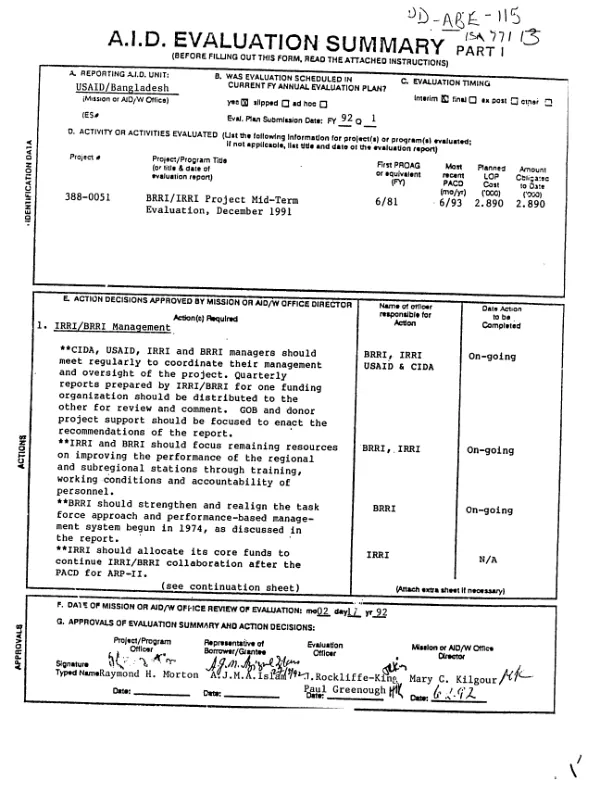
BRRI/IRRI project : mid-term evaluation
The Bangladesh Rice Research Institute/International Rice Research Institute (BRRI/IRRI) Rice Research and Training project was established in 1975 with funding from the Ford Foundation and the governments of Australia and Canada.
1992
Sign in to readA free account is required to download.
Abstract
Phase II of the project began in 1981, with USAID involvement in the consortium of donors. Phase III began in 1/88, and is funded through 6/91 with USAID support in the amount of $2 million and Canadian International Development Agency (CIDA) support of US$1.4 million. The project has been extended until 6/93, with additional U.S. funding of $760,000. Project assistance is provided to strengthen BRRI"s institutional capacity to develop and deliver relevant research findings to farmers. The project is well managed and supports BRRI objectives. BRRI is now a mature research institute with more than 200 research officers. About 60% hold M.Sc. degrees and 14 percent hold Ph.D"s. BRRI breeders have developed 26 modern varieties (MV"s) since 1970. MV"s account for about 50% of the area planted to rice and produce about 72% of total rice harvested. About 93% of rice grown during the dry winter boro season is MV. BRRI follows accepted international standards of plant breeding. BRRI MV"s generally outperform local varieties at low levels of fertilizer use. Present MV"s have long straw to feed draft animals and to clear flood waters common during aus and aman seasons. BRRI pioneered on-farm cropping systems research. The methodology used does not require expensive fixed site infrastructure. It is more cost-effective than other models used in Bangladesh. In the future, additional priority is needed to develop new, sustainable, disease-resistant, and input-efficient high-yield varieties suitable for growth during the irrigated winter boro season. Additional yield increases can release land now planted with rice to promote needed crop diversity. BRRI does not require continued TA from IRRI after the close of the current project in 6/93. But an IRRI liaison officer, paid from core funds, should still be provided to ensure continuation of professional collaboration between the two institutes. IRRI supported mini-projects are of major benefit to BRRI and should continue. The following lessons learned are noted. Much more rice technology is available than has been transferred to farmers. BRRI, along with the donor community, should investigate additional technology transfer approaches, including expanded training and involvement of the NGO community. Holding regular farmer field days, including demonstrations, as part of the farming system research program may promote greater farmer/researcher dialogue and feedback. The potential role of other private sector organizations in the technology transfer process, including input suppliers, should be investigated. (Author abstract)
Related documents