USAID. MISSION TO HONDURAS
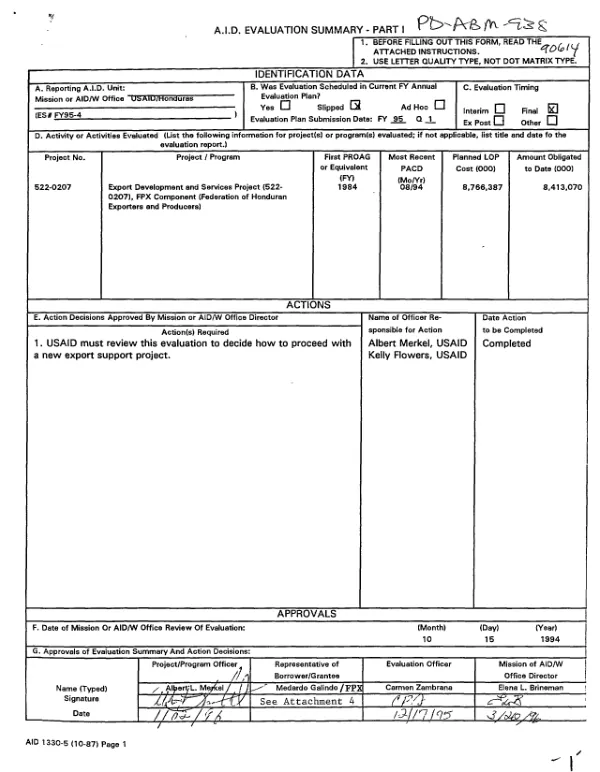
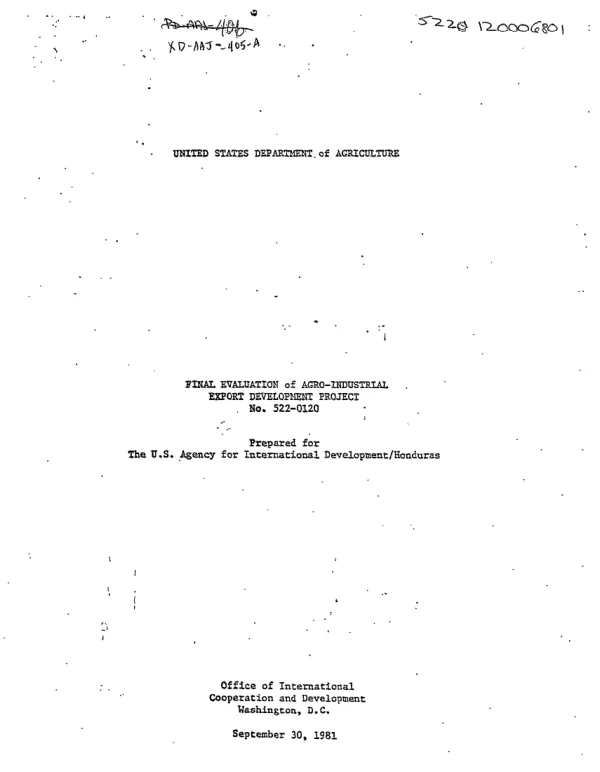
Agro-industrial export development
Evaluates project to expand the produce market for small farmers in Honduras.
1978
Sign in to readA free account is required to download.
Abstract
Evaluation covers the period 9/76-6/78 and is based on a special evaluation conducted by an agricultural economist and a socio-anthropologist. Project implementation has taken much longer than planned and progress has been mixed. The fresh vegetable component has been enthusiastically received and has had a positive financial effect on farmers, peasants, and the Standard Fruit Company; the two Government of Honduras (GOH) agencies involved view it as a model for helping small farmers and promoting exports. High yields of cucumbers were produced and exported, but technical problems limited tomato production. Transfer of growing and packing technologies has been largely successful; technical feasibility and marketing studies have also been proceeding satisfactorily. The processed vegetable component, however, is at a standstill because of poor relationships between the farmers and the processor, Mejores Alimentos (MA). MA is unable to obtain sufficient raw materials because it will not pay farmers a reasonable price for their produce. Moreover, it is not committed to the project strategy of promoting exports to U.S. markets. Peasant groups have borne all the financial risks of this component and have lost heavily. Finally, institution building activities have been limited. A vegetable technician team has been formed at the Ministry of Natural Resources (MNR), an agribusiness seminar has been conducted for GOH officials, and graduate scholarships were provided to three Ministry of Economy officials. Key recommendations are: (1) extend the project by 4 years and formally transfer implementation power to the MNR; (2) make funding of new activities contingent upon favorable future evaluations; (3) hire a local project manager; (4) renew the Standard Fruit contract; (5) begin cropping cycles during early October so crops are ready for the winter market; (6) hire a long-term contractor to design and manage the packing plant; (7) provide MA with technical assistance (TA) to ascertain the feasibility of paying farmers higher prices and providing then with TA and improved transport; and (8) provide additional training to the MNR vegetable unit and GOH officials.