USAID DEC
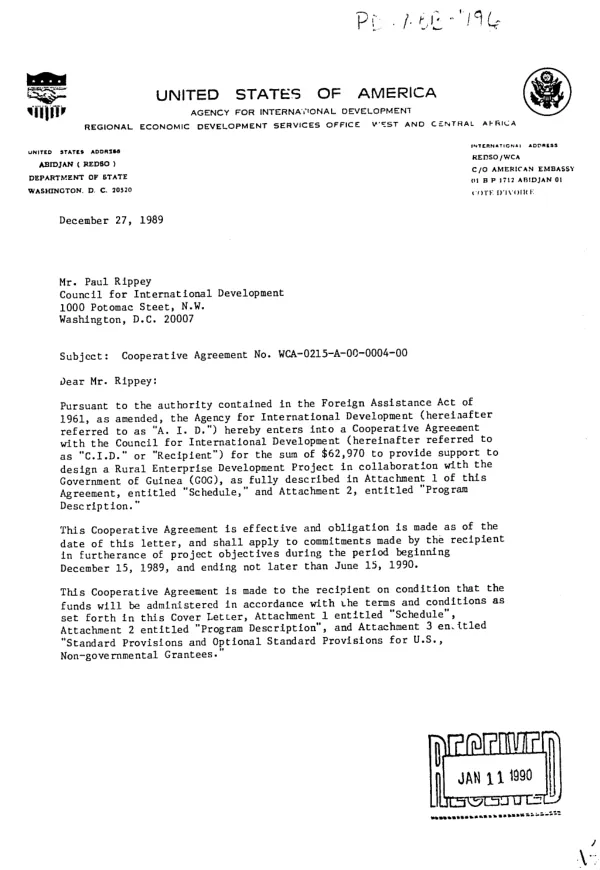
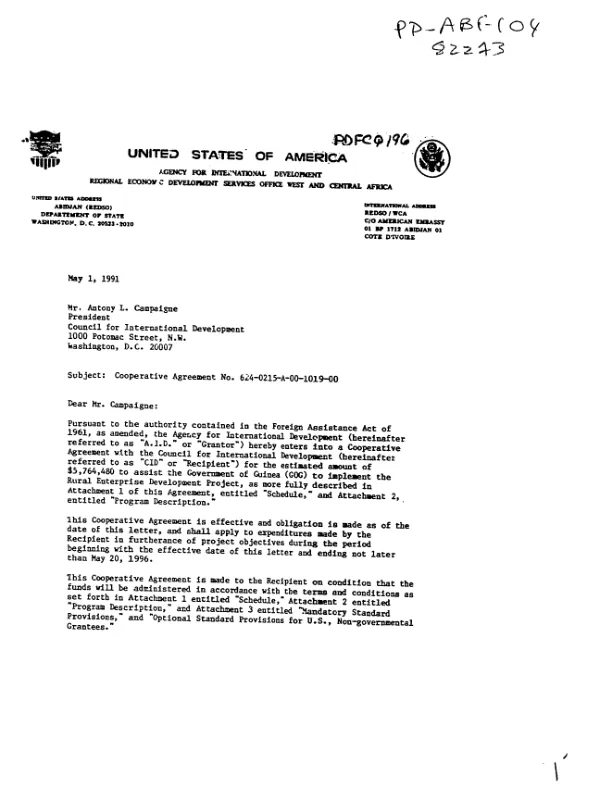
AID cooperative agreement no. 624-0215-A-00-1019-00 with the Council for International Development to assist the Government of Guinea to implement the rural enterprise development project
Sign inUSAID. BUR. FOR AFRICA. REGIONAL ECONOMIC DEVELOPMENT SERVICES OFC. (REDSO) WEST AND CENTRAL AFRICA
AID cooperative agreement no. 624-0215-A-00-1019-00 with the Council for International Development to assist the Government of Guinea to implement the rural enterprise development project
Grant to the Council for International Development (CID) to help develop small enterprises in rural Guinea.
1991
Sign in to readA free account is required to download.
Abstract
The project"s zones of operation will be the prefectures of Mamou, Boke, and Dubreka. CID"s chief activities will be to provide financial services and entrepreneurship training. Under the financial services activity, known as Credit Limanya, CID will provide small amounts of credit and, eventually, savings facilities, to large numbers of small rural producers. Through a system of field agents, trained and supervised by CID branch managers, CID will publicize the availability of credit to villagers. Candidates for credit will be organized into groups of five and trained by the field agents. The agents will inform the groups of borrower responsibilities (each group is liable for the defaults of any of its members), how to identify viable economic activities, and other necessary information. The initial loan ceiling will be GNF 100,000; this may be raised if CID can ensure that poor and female borrowers will not be squeezed out by larger requests. Initially, loans will be given to two members of a group; when these loans have been performing perfectly for two months, two more members will receive loans; if these perform well, the group leader will receive his/her loan. Under the training component, CID (working through a subcontractor) will develop an entrepreneurship workshop, tailored to the context of business in rural Guinea. The subcontractor will train Guineans to become trainers and eventually take full responsibility for the workshops. Additional management training and financial services will be provided to more advanced entrepreneurs, primarily graduates of the workshop. CID will develop specialized training modules and TA in, inter alia, recordkeeping, marketing and sales, personnel management, licensing and taxes, banking operations, and import/export formalities. These enterprises will also be helped to gain access to commercial bank credit and to lines of credit already established by other donors. Other project activities will include: (1) a private sector development education program which will consist of workshops, publications, and the creation of a national advisory council, all designed to demonstrate successful entrepreneurship; (2) development of a subcontracting exchange in the town of Kasmar, to link the mining enclave there to local suppliers of goods and services; (3) technical and management follow-up of entrepreneurs gaining financial assistance through the project; (4) training of small enterprise facilitators -- including local NGO managers; cooperative managers, government officials, and representatives of financial institutions; and (5) a limited number of pre-feasibility studies and subsector analyses, along with the preparation of technical information sheets to assist types of enterprises most likely to receive assistance, such as rice decorticators.
Related documents