USAID DEC
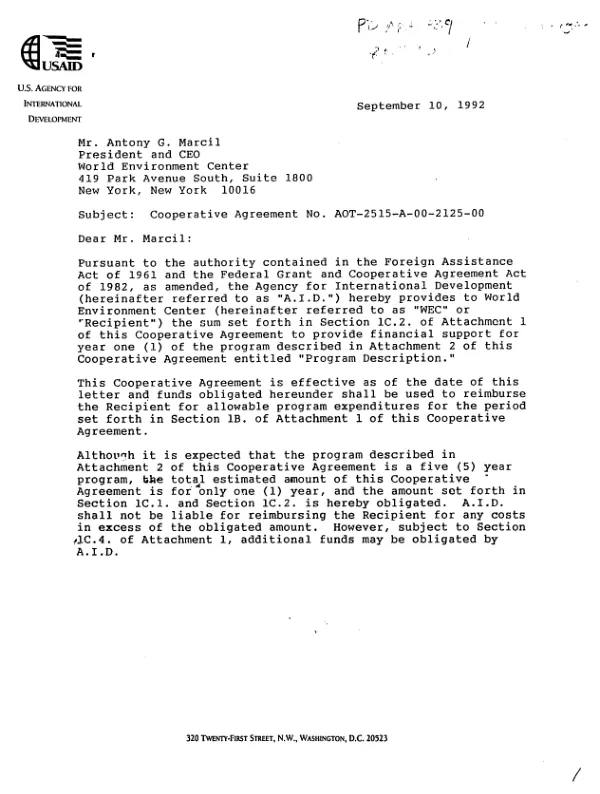
AID cooperative agreement no. AOT-2515-A-00-2125-00 with the World Environment Center for a program of prevention, mitigation and preparedness which will address man-made environmental disasters in high-risk locations
Sign inUSAID. OFC. OF U.S. FOREIGN DISASTER ASSISTANCE (OFDA)
AID cooperative agreement no. AOT-2515-A-00-2125-00 with the World Environment Center for a program of prevention, mitigation and preparedness which will address man-made environmental disasters in high-risk locations
Grant to World Environment Center (WEC) to develop replicable local accident mitigation and prevention (LAMP) programs at targeted sites.
1992
Sign in to readA free account is required to download.
Abstract
LAMP programs will enhance local capacity to prevent/mitigate accidents at locations where there is a high risk of chemical explosion or exposure. WEC, with the cooperation of the U.S. Office of Foreign Disaster Assistance (OFDA), will enhance local capacity to identify chemical hazards and vulnerabilities, prevent/mitigate chemical emergencies, address chemical handling protocols, and prepare for and respond to technological disasters. Building on its involvement in the UN Environmental Program"s Awareness and Preparedness for Emergencies at the Local Level (APELL) workshops, WEC will train representatives from industry, government, and community organizations to form hazards planning and response organizations at each selected site. These APELL/LAMP teams will: (1) catalogue potential hazards; (2) develop, at both the industrial plant level and the community level, emergency preparedness and response plans that address defined accident scenarios; (3) periodically test and revamp these plans; (4) ensure that local industries have committed resources to the LAMP program; (5) integrate industrial and regional response capabilities for both natural and technological disasters; (6) provide training as called upon; (7) strengthen regional "nodal" groups (e.g., national safety councils, NGOs) to maintain LAMP functions; and (8) build reliable independent channels through which disaster assistance can be delivered. It is expected that full LAMP programs can be established in Colombia, Turkey, India, Brazil, Thailand, Indonesia, the Philippines, and Mexico, countries where there is a significant exposure to both technological and natural disasters. Selected activities could also be financed in Egypt and Poland, where the technological risks are great, but natural disaster exposure is lower. Activities will be tailored to the needs of each specific site.
Related documents
Documents in this collection
 1993
1993USAID DEC
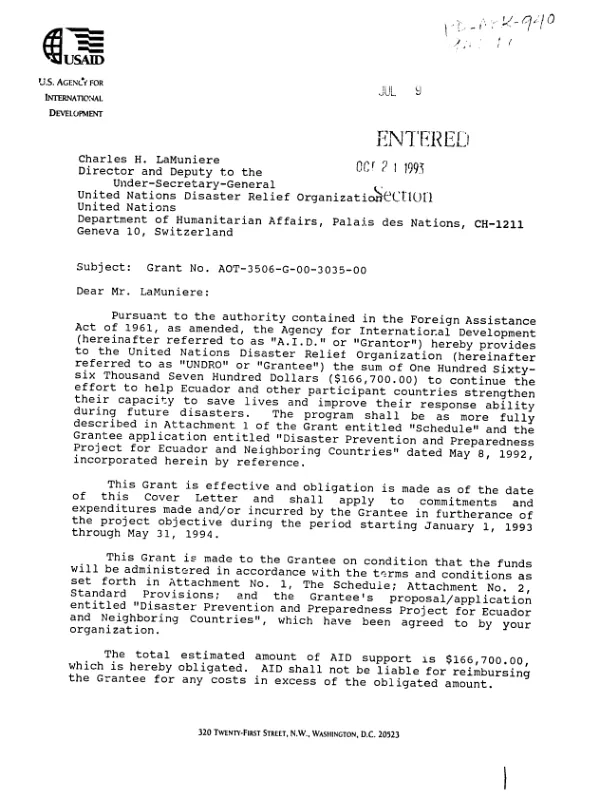
AID grant no. AOT-3506-G-00-3035-00 to the United Nations Disaster Relief Organization (UNDRO) to support the `Disaster prevention and preparedness project for Ecuador and neighboring countries`
Open record 1994
1994USAID DEC
![AID grant no. AOT-3507-G-00-3188-00 to the Pan American Health Organization [PAHO] for disaster mitigation and preparedness in the health sector of Latin America and the Caribbean](https://covers.devme.ai/gen/46703.webp)