USAID DEC
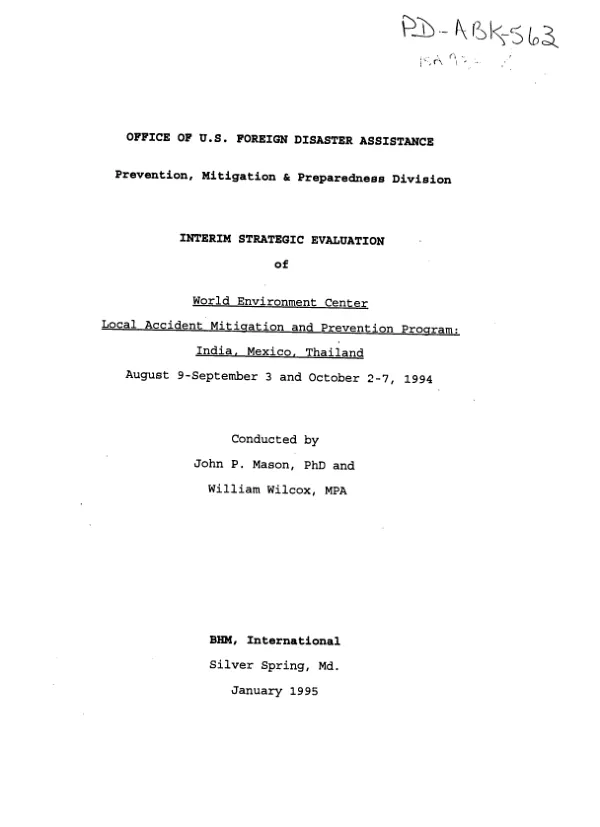
Interim strategic evaluation of World Environment Center local accident mitigation and prevention program : India, Mexico, Thailand -- August 9-September 3 and October 2-7, 1994
Sign inBASIC HEALTH MANAGEMENT INTERNATIONAL (BHM)
Interim strategic evaluation of World Environment Center local accident mitigation and prevention program : India, Mexico, Thailand -- August 9-September 3 and October 2-7, 1994
This interim strategic evaluation of the World Environment Center (WEC) Local Accident Mitigation and Prevention Program (LAMP) was carried out in India, Mexico, and Thailand from August to October, 1994.
Mason, John P.|Wilcox, William · 1994
Sign in to readA free account is required to download.
Abstract
Indonesia, the fourth country in the program, was omitted from the evaluation because of a U.S. Embassy ban on official travel. WEC-LAMP is designed to meet Office of U.S. Foreign Disaster Assistance (OFDA) objectives of reduced loss of lives, increased awareness of accidents, and improved response to technological, namely chemical, emergencies. Begun in late 1992, LAMP is funded at $3.5 million for 5 years. The most consistent feature of chemical emergency planning in India, Mexico, and Thailand is that such planning is industry and government driven. Citizen groups, particularly those of a grass roots nature, are generally on the outside looking in, despite the fact that WEC-supported courses and workshops have stressed the role of citizen awareness. Beside the constraint of inadequate citizen participation lies the related problem of training for rank-and-file emergency first responders. Since much of the WEC-LAMP emergency training is directed to management and technical personnel, first responders such as police and fire personnel have until now been widely overlooked. Important questions for this evaluation are: (1) how useful has the LAMP program been in the three countries and (2) what are its chances of being sustained? For the first question, all three countries have benefitted from this program. As to the long range sustainability question, answers vary substantially. In India, management of the LAMP by the highly regarded National Safety Council along with the creation of a National Advisory Council should assure progress long after OFDA's funding has ceased. In Mexico, the execution of agreements with national and state governments and the presence of a culture of disaster awareness should contribute to its post-funding continuation. In Thailand, the program is almost entirely carried by the vigor and commitment of the project manager; however, because WEC has not fully engaged top national disaster managers, continuation of its results will mostly occur at the industrial estate level, which in itself is an acceptable outcome given the shorter remaining time-frame of WEC-Thailand. It is expected that the LAMP program could have long-range impacts. As detailed in this report, all three country programs have made contributions of considerable value to chemical safety. No doubt some of these achievements will have a favorable impact in the years ahead. The program has achieved significant progress in the technical and management domains of emergency preparedness. However, little progress has been made in the social and community development areas. Insufficient attention, for example, has been given to technical assistance in developing a corps of trained emergency responders either through a train-the-trainers approach or otherwise. This is due in part to a top-down orientation in the three countries, but also because of a lack of assistance from WEC-Washington to the three countries in addressing this constraint. Secondly, the three country programs have not demonstrated significant advances in encouraging the enrollment of the community as an equal partner with the industrial and government sectors in the chemical emergency planning process. Furthermore, there is no evidence that WEC-Washington has in any significant manner encouraged the correction of this shortcoming through technical assistance of community development or social science experts, including members of active local emergency planning committees in the U.S. (Author abstract)
Related documents
Documents in this collection
 1992
1992USAID DEC
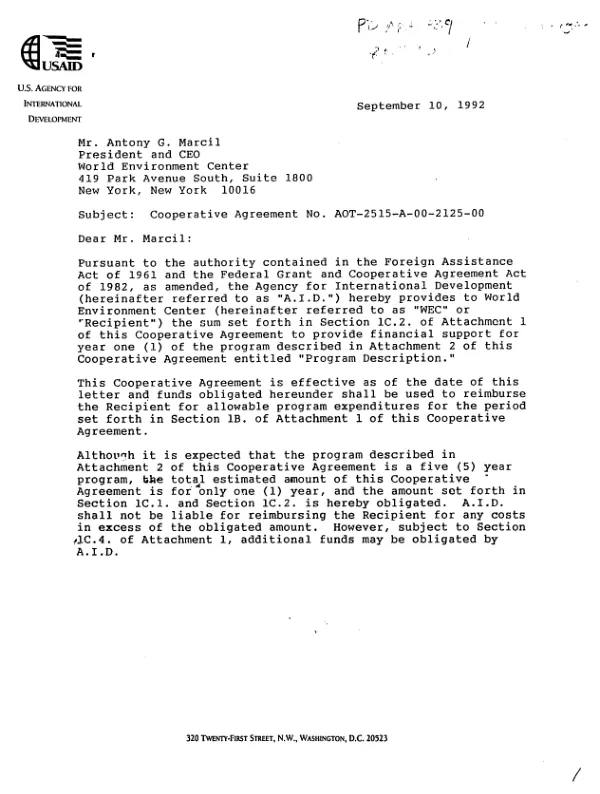
AID cooperative agreement no. AOT-2515-A-00-2125-00 with the World Environment Center for a program of prevention, mitigation and preparedness which will address man-made environmental disasters in high-risk locations
Open record 1996
1996USAID DEC
![Evaluation of AID"s Office of Foreign Disaster Assistance"s grant to the Organization of American States in support os [of] its natural hazards mitigation project](https://covers.devme.ai/gen/14524.webp)
![Evaluation of AID's Office of Foreign Disaster Assistance's grant to the Organization of American States in support os [of] its natural hazards mitigation project](https://covers.devme.ai/gen/7994.webp)