USAID DEC
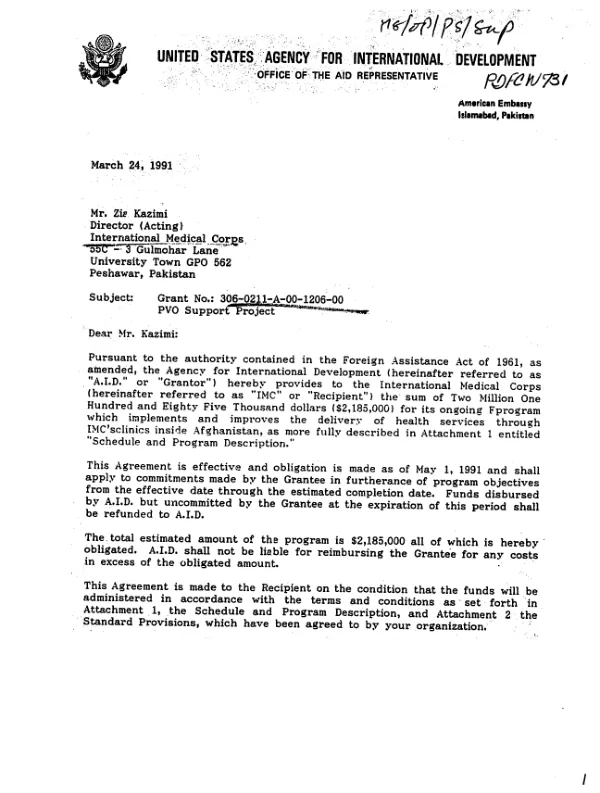
AID grant no. 306-0211-A-00-1206-00 to the International Medical Corps for its ongoing program which implements and improves the delivery of health services through IMC"s clinics inside Afghanistan
Sign inUSAID. MISSION TO PAKISTAN. OFC. OF THE AID REPRESENTATIVE FOR AFGHANISTAN AFFAIRS
AID grant no. 306-0211-A-00-1206-00 to the International Medical Corps for its ongoing program which implements and improves the delivery of health services through IMC"s clinics inside Afghanistan
Grant is provided under the PVO Support Project (3060211) to International Medical Corps (IMC) to improve the delivery of health services through its network of 56 clinics and small hospitals in rural, Resistance-held Afghanistan.
1991
Sign in to readA free account is required to download.
Abstract
The grant will support such activities as health worker retraining, clinic/hospital operations, and immunization. Refresher training for up to 60 mid-level health workers (medics) will be provided via an A.I.D.-supported training consortium implemented in cooperation other PVOs and agencies working in Afghanistan. IMC will be an active participant in the consortium, providing retraining at its Training Hospital at Nasir Bagh (located near an Afghan refugee camp outside of Peshawar, Pakistan), and if needed, at another site. A.I.D. will not fund any additional training of new medics (with the exception of female MCH workers) as IMC will have already trained enough new medics to place at least two at 90% of its clinics. Advanced clinical training courses (funded primarily by WHO) will be provided for some 24 Afghan physicians who will then work with IMC as physician/monitors or direct providers of care at clinics inside Afghanistan. A.I.D., along with WHO and other donors, will also help to support Gulbahar Hospital in Kapisa, Afghanistan (which is one of the largest and most comprehensive hospitals in northern Afghanistan) as well as the five new district-level hospitals which are being constructed with WHO funding. Linking these district-level facilities with clinics so they can serve as central referral sites will be a key objective. Immunization activities will be doubled in Gaghlan, Badghis, Kunduz, Faryab, Samagan, Takhar, Ghorat, Jowzjan, Balkh, Logar, and Herat Provinces, resulting in the immunization of more than 100,000 children and almost 50,000 women against measles, polio, diphtheria, pertussis, tuberculosis, and tetanus. This activity is primarily funded by UNICEF, with less than 10% of its support from A.I.D.; recurrent costs will be borne by UNICEF. Finally, IMC will continue its efforts to recruit Afghan senior field staff, will support revenue-generating activities at 5% of the clinics and one hospital inside Afghanistan, and will cut costs at all facilities by revising the types and quantities of pharmaceutical supplies procured and the systems utilized for distribution.
Related documents
Documents in this collection
 1992
1992USAID DEC
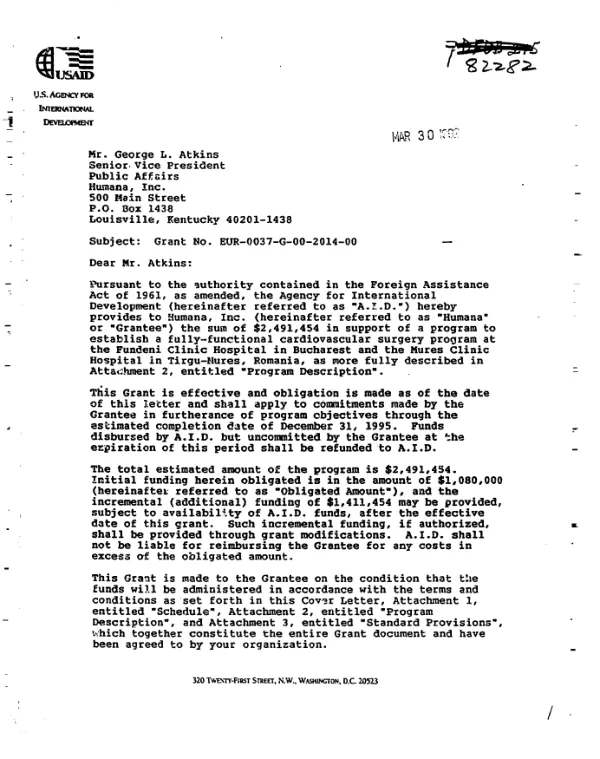
AID grant no. EUR-0037-G-00-2014-00 to Humana, Inc. in support of a program at the Fundeni Clinic Hospital in Bucharest and the Mures Clinic Hospital in Tirgu-Mures, Romania
Open record 1991
1991USAID DEC