USAID DEC
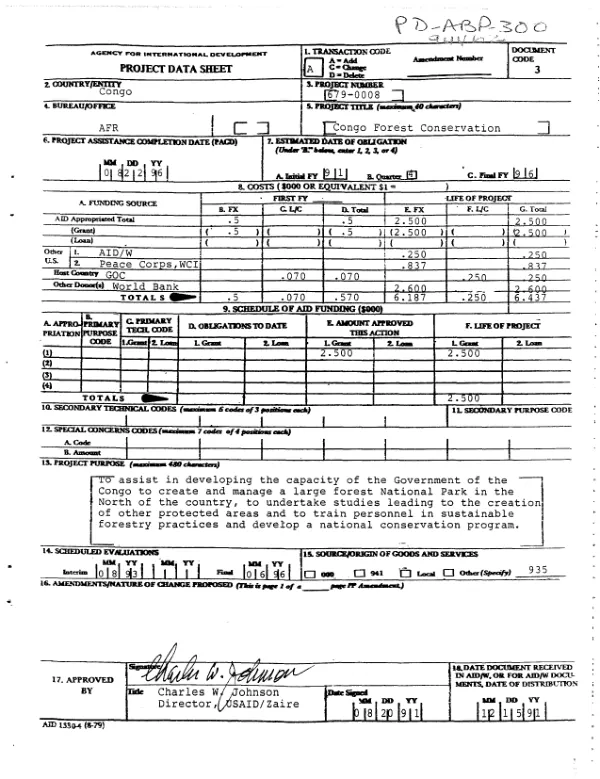
AID grant no. 679-0008-G-00-1384-00 to Wildlife Conservation International in support of a program to develop forest conservation in the Republic of Congo
Sign inUSAID. MISSION TO THE PEOPLE'S REPUBLIC OF THE CONGO
AID grant no. 679-0008-G-00-1384-00 to Wildlife Conservation International in support of a program to develop forest conservation in the Republic of Congo
Project to promote forest conservation in the Congo, principally by creating a national park in Nouabale-Ndoki, a major area of virgin forest and biological diversity in northern Congo which is potentially threatened with takeover by a logging concessionaire.
1991
Sign in to readA free account is required to download.
Abstract
The project, to be implemented by Wildlife Conservation International in coordination with Ministry of Forest Economics and with assistance from 5 Peace Corps volunteers, will also include national-level conservation activities. Activities leading to establishment of Nouabale-Ndoki National Park will include a series of surveys and assessments: (1) plant and large mammal inventories; (2) analysis of potential economic impacts, including a study of the logging concession adjacent to the proposed park; (3) sociological assessment of potential impacts on Bayaka (Pygmy) and other populations. Because elephants are found in higher densities in Nouabale-Ndoki than almost anywhere else in Africa, they will receive significant study, focusing on population sizes, movements, social structure, reproduction, genetics, and levels of poaching. The process of gazetting the reserve began in 1989, and has been received favorably by the Government of the Congo (GRC); as data are received from the surveys and assessments, modifications can be made in the reserve proposal. A management plan and an action plan will be developed for the park, addressing issues of reserve boundaries, legal status, constraints on use, mandatory protection efforts, infrastructure development, training needs, mechanisms for monitoring human use and wildlife populations, and priority research themes. The project will put in place a basic infrastructure for park management and protection, as well as a community-based environmental education program. It will also explore the economic potential of the park area by examining the feasibility of introducing nature tourism and safari hunting. Throughout the project, emphasis will be put inclusion of Congolese personnel at all levels of implementation. With this in mind, on-the-job training will be provided to two high-level administrators, a scientific coordinator, a cadre of graduate and technical students, local field technicians, park guards, and guides (to be hired from the Bayaka community). As an adjunct to the project, outside funding will be sought, probably from the World Bank and the German Association for Technical Cooperation, to develop a management plan for a buffer zone around the park. Activities at the national level will fall into four categories: (1) assistance to the GRC in surveying endangered species in three areas (Lac Telle and the vast Likouala aux Herbes swamps; Garabinzam, in a large tract of virgin forest in the northwest; and Conkouati reserve in the Layombe); (2) assistance with a permanent conservation infrastructure and management policy to be established by the GRC with help from the World Bank; (3) a variety of training and TA, including surveys and expeditions, short courses and workshops, and site exchanges with other African reserves, e.g., Dzanga-Sangha in the Central African Republic, which adjoins Nouabale-Nkoti, with emphasis on affording field experience to already academically trained Congolese biologists; and (4) a national program of environmental education.