DEVELOPMENT ALTERNATIVES, INC. (DAI)
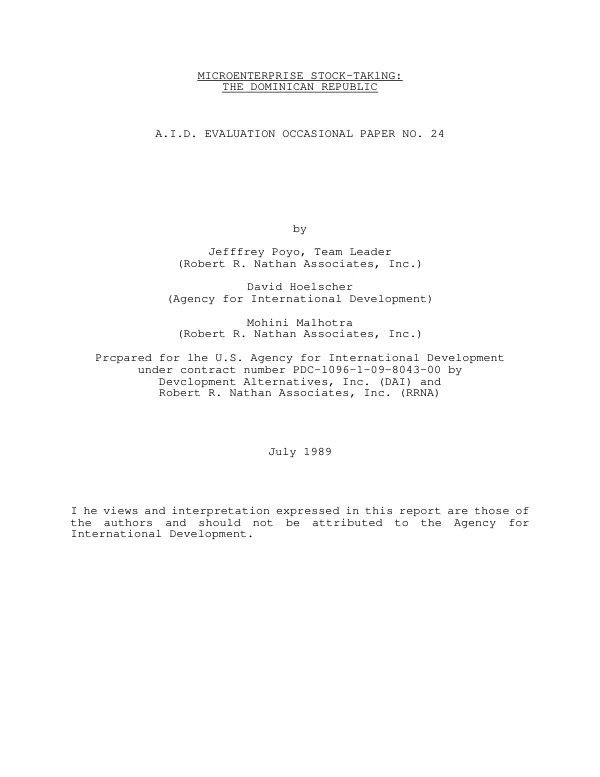
AID microenterprise stock-taking : Ecuador
Ecuador's microenterprise sector plays a major role in generating urban employment, accounting for about two-thirds of private sector employees.
Chang, John|Cannellas, Andrew A.|Poyo, Jeffrey · 1989
Sign in to readA free account is required to download.
Abstract
Nationwide, microenterprises (defined as non-farm firms with fewer than 10 employees) number 153,000, or 97.6% of all firms. This report evaluates the Small Enterprise Development Project (SEDP), a project to expand and improve the supply of credit, TA, and representational services to Ecuador's small enterprise sector. Although it is too early to accurately measure project performance, it is clear that progress has been hampered by a design that is extremely complex and difficult to implement without alterations. Furthermore, changes in economic and political conditions, as well as in judgments about A.I.D. project elements and contractors, has led to a number of components either not implemented or implemented in random sequence. Despite these problems, some accomplishments have been made. About 2,800 loans totalling roughly $54,000 were administered to small entrepreneurs and street vendor solidarity groups. About 575 small manufacturing enterprises have received in-depth technical assistance (TA), surpassing the target of 400. Programs consisting of shop seminars, clinics, practical courses, and individual TA are 69% completed, and 21 technical manuals have been published, far exceeding the objective of 5. The representational component and an activity to provide TA to credit guarantee corporations are not yet operational. Five lessons are drawn from this project: (1) complicated, integrated projects are difficult to implement, especially in rapidly changing environments; (2) it is easier and cheaper to implement a project through existing organizations than to create new ones; (3) project design is dependent on political and economic conditions that can change faster than project implementation; (4) financial sustainability is hard to achieve unless credit and TA components are separately funded and evaluated; and (5) graduation of clients into the formal credit sector is often very difficult to achieve.