USAID DEC
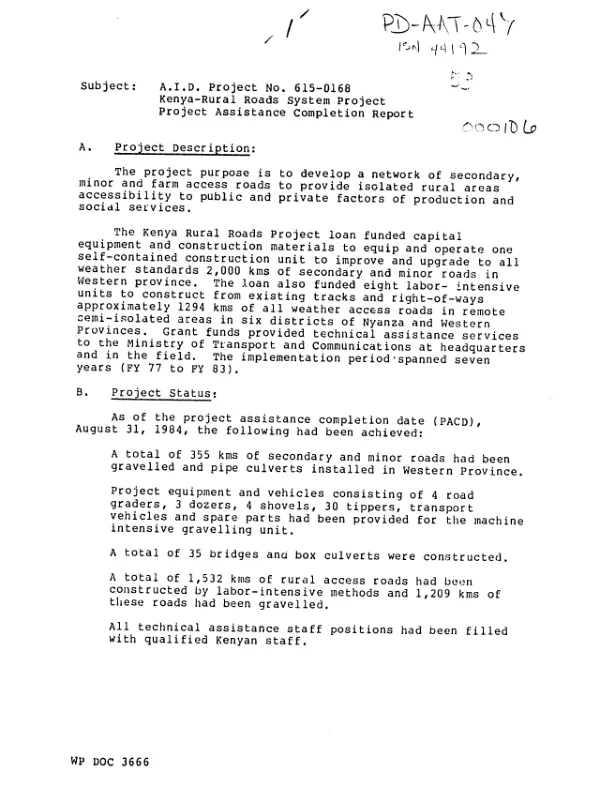
AID project no. 615-0168, Kenya - rural roads system project : project assistance completion report
Sign inUSAID. MISSION TO KENYA
AID project no. 615-0168, Kenya - rural roads system project : project assistance completion report
Presents final report (1977-8/84) on a project to help the Government of Kenya (GOK) develop a network of secondary, minor, and farm access roads to provide isolated rural areas with access to public and private factors of production and social services.
Thuo, J.|MacDonald, V. · 1986
Sign in to readA free account is required to download.
Abstract
All project TA positions have been filled with qualified Kenyan staff, and the project's road construction component exceeded targets. Labor-intensive construction units built 1,532 kms (vs. a targeted 934) of rural access roads from existing tracks and right-of-ways; some 1,209 kms of these roads have been gravelled, and the remainder will be gravelled by the GOK. The project's equipment-intensive road gravelling component was less successful, upgrading only 355 km (vs. a targeted 2,000) of secondary and minor roads, due to (1) a decision that full-length upgrading, rather than the planned spot improvements, was necessary to bring the roads to all-weather quality, and (2) work stoppages due to insufficient GOK operating funds. Also, the original target of 30-35 kms per unit per month for the gravelling component was never met; an achievable target of 10-15 kms a month was subsequently established. Impact studies undertaken by the GOK have indicated a positive relationship between road improvement, traffic volume, and increased cash incomes. Lessons learned are: (1) labor-intensive road construction methods can be successfully used to improve low-traffic rural roads; (2) careful scheduling of construction and gravelling activities is necessary to avoid large backlogs of ungravelled roads; (3) maintenance should begin as soon as roads are completed, and maintenance staff and equipment should be procured in advance of road completion (in this project, some roads did not receive adequate maintenance early on due to delays in recruiting staff and procuring vehicles); (4) spot improvements on earth roads were not successful, but spot improvement does provide sufficient quality upgrading on earth tracks or roads not originally built to engineered standards; and (5) during project design, the capability of the host implementing agency should be evaluated carefully in order to avoid implementation problems; e.g., in this project, chronic stoppages were initially experienced due to cash flow problems.
![Evaluation of Eastern ORD rural roads project (686-0215)[, Upper Volta] : final report, volume I](https://covers.devme.ai/gen/2316.webp)