USAID DEC
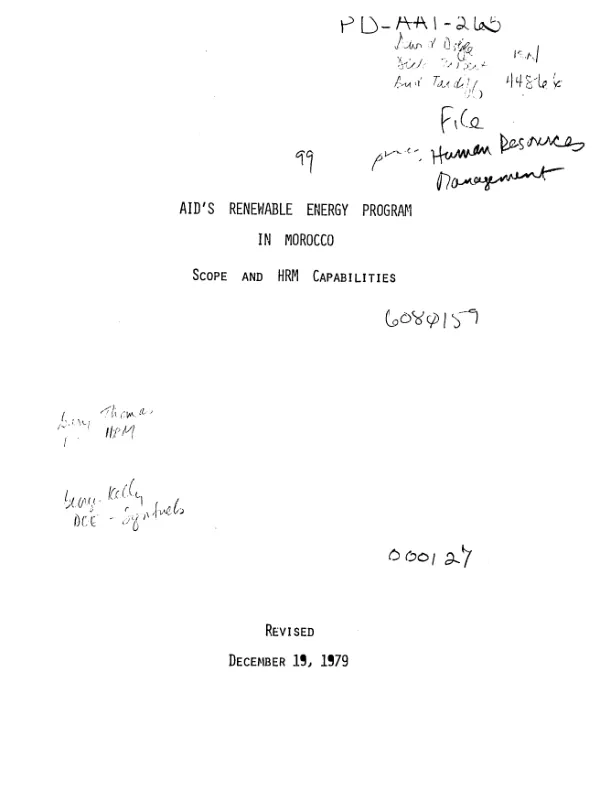
AID's Renewable Energy Program in Morocco
The Agency for International Development's (AID) Renewable Energy Program in Morocco is a comprehensive initiative aimed at establishing a renewable energy program in the country.
17 pages
Sign in to readA free account is required to download.
Abstract
The program will be directed by a program manager based in the Washington office of HRM, who will provide overall direction and support to the program and serve as the primary liaison with AID/Washington. The program will consist of several interrelated tasks and activities, including the establishment of a Renewable Energy Center, mini-hydro energy option assessment, and solar irrigation for Morocco. A long-term advisor will be selected and located in Morocco to provide direct support to the Government of Morocco and the AID/Rabat mission in developing an alternative energy program. The scope of the program is divided into two phases: Phase I, Feasibility, Planning, and Organization, and Phase II, Implementation. Phase I will involve the development of a conceptual design for the Renewable Energy Center and laboratory, as well as the identification of potential sites for mini-hydro energy option assessment. The program will also involve the analysis of relevant data and studies, including data already collected and analyzed by AID. The program will require the collective talents of a team of six individuals, including an architect engineer, a laboratory specialist, an economist, a sociologist, an environmental expert, and a solar technologist. The team will be responsible for completing several subtasks, including the selection of three sites for the demonstration phase, the collection and analysis of relevant data, and the examination of the sociological, developmental, and environmental aspects of selected sites. The program will also involve the review of the Moroccan mini-hydro industrial base to determine indigenous capabilities for fabrication of components, design, construction, and maintenance of multiple mini-hydro systems. The team will aim to minimize the use of imported components, materials, and labor. The program will require a significant amount of effort, with an estimated 12 person-months required for Task A, Renewable Energy Center and Laboratory, and 2-3 months required for Task B, Mini-hydro Energy Option Assessment. The program will also involve the preparation of a comprehensive cohesive plan for the Renewable Energy Center, which can be used for specific programs addressed in this initiative as well as other renewable energy programs. The program will be implemented in a phased approach, with Phase I focusing on feasibility, planning, and organization, and Phase II focusing on implementation. The program will involve the coordination of team efforts, the provision of participant training, and the necessary interfaces between field team members and participants. HRM will handle all logistics and assignments for the participant training, and the long-term advisor will be nominated by HRM and approved by AID/Washington and AID/Rabat. The program will also involve the provision of backstopping and assistance throughout the project, including the provision of quick response to specific requests for energy-related assistance and information. The program will aim to establish a strong, long-term relationship between the Renewable Energy Center and the mini-hydro, solar, and training activities, which are part of this renewable energy program with Morocco.
Related documents
![Atelier d'evaluation de la FNAM [Federation Nationale des Associations de Microcrdit] du 07 au 09 mai 2004 au centre de la CNSS Marrakech[, Maroc]](https://covers.devme.ai/gen/144273.webp)