ECO CONSULTING GROUP
Social and Emotional Learning Systematic Review - Study Brief
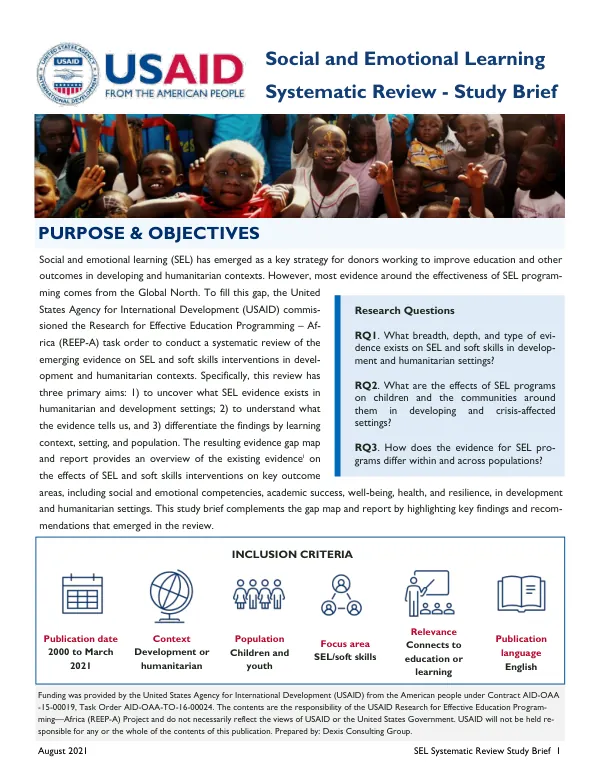
The systematic review study brief on social and emotional learning (SEL) was commissioned by the United States Agency for International Development (USAID) to fill the gap in evidence on the effectiveness of SEL programming in developing and humanitarian contexts.
2021 · 6 pages
Sign in to readA free account is required to download.
Abstract
The review aimed to uncover existing evidence on SEL and soft skills interventions, understand the effects of these interventions, and differentiate findings by learning context, setting, and population. The study brief highlights key findings and recommendations that emerged from the review. A total of 136 studies representing 110 unique interventions with SEL components met the inclusion criteria. The majority of these studies were impact evaluations, though they varied in rigor and quality. The majority of interventions occurred in a development context, with nearly half of the studies occurring in sub-Saharan Africa. The review found that targeted, explicit SEL instruction is associated with positive effects on social and emotional and other outcomes. Interventions that actively engage children and youth, provide focused time on developing SEL skills, and explicitly target specific competencies prove to be the most effective. Studies that integrated SEL often saw promising effects on other outcomes, even when no effects on social and emotional competencies were found. The review also found that there is insufficient research on the effects of teachers' own SEL skills and knowledge on student outcomes. Interventions that primarily targeted SEL did not see improvements in mental health outcomes, and vice versa. SEL should not be used as a replacement for targeted mental health interventions, nor do mental health interventions necessarily build SEL skills. The study brief highlights the importance of considering the specific needs of marginalized groups, including orphans and vulnerable children, children with disabilities, and those affected by conflict. The review found that these groups often outperform non-marginalized groups on SEL or other target outcomes when their specific needs are taken into account in the program design. The review also emphasizes the importance of context in determining the effectiveness of SEL programs. Without engaging local communities, a program may contradict local values, norms, and practices, which can undermine its effectiveness. The study brief concludes that SEL programs can be effective in humanitarian and development contexts, but their effectiveness depends on various factors, including the specific context, program design, and target population. The review's findings have implications for the design and implementation of SEL programs in developing and humanitarian contexts. The study brief recommends that SEL programs be tailored to the specific needs of the target population, and that they be designed to engage local communities and address structural issues that may interfere with their effectiveness.
Related documents