USAID DEC
Albanian Justice Sector Strengthening Project (JuST) Quarterly Report for July – September, 2011
Sign inCHEMONICS
Albanian Justice Sector Strengthening Project (JuST) Quarterly Report for July – September, 2011
The Albanian Justice Sector Strengthening Project (JuST) is a five-year initiative aimed at improving the justice delivery system in Albania.
2011 · 12 pages
Sign in to readA free account is required to download.
Abstract
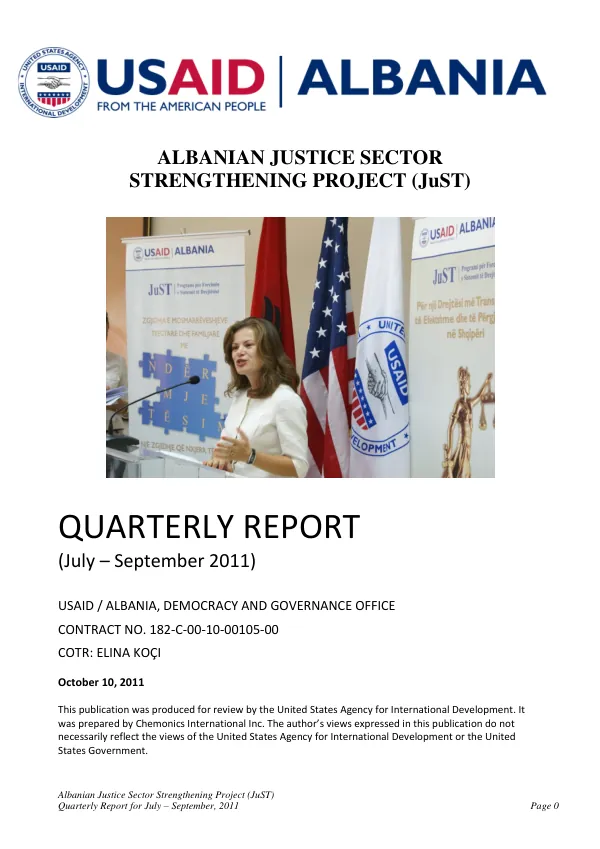
The project is part of the ongoing U.S. support to the rule of law and good governance in Albania, with an emphasis on improving justice delivery and increasing public demand for accountability in the justice sector. The project works in three broad and inter-related areas. First, it aims to increase court transparency, fairness, and efficiency by working with justice sector institutions. This includes establishing systems for producing and making available verbatim records of legal proceedings, promoting greater use of public courtrooms for the public benefit, and introducing and expanding the use of mediation for resolving commercial and family disputes. During the second quarter of the project, several activities were initiated or completed. Continuing Legal Education (CLE) classes were held with local Chambers of Advocates in Durrës and Vlora in July and September. Mediation training was conducted in Durrës and Korça, and a Court-Connected Mediation Program was inaugurated in Korça by U.S. Ambassador, USAID Mission Director, and Albanian justice sector leaders. The project also issued a Request for Proposals for digital audio recording equipment for 130 courtrooms, evaluated proposals, and selected a provider. An Advisory Committee on audio recording was convened, and a grants program to strengthen civil society organizations (CSOs) was developed and launched. Training for CSOs in advocacy, court monitoring, lobbying, and coalition building was organized. In addition, the Union of Albanian Judges held a General Assembly on July 2, and a new board began strategic planning. A Media Capacity Assessment of Journalists was completed in cooperation with IREX and local experts from the Albanian Media Institute. Work planning for Year 2 activities was also completed. The project's third component aims to strengthen the legal profession and legal education in Albania. This includes establishing the Bar Journal, convening a National Conference of Lawyers, developing and implementing a Continuing Legal Education (CLE) Program, creating and implementing a work plan with the Magistrates School of cataloging Supreme Court decisions and ratified conventions, and establishing and implementing an Assistance Plan for the Law Clinic. The project's performance indicators include the number of CLE classes held, the number of mediation training sessions conducted, the number of courtrooms equipped with digital audio recording equipment, and the number of CSOs strengthened through the grants program. The project's quarterly accrual report provides a detailed breakdown of the project's financial transactions and expenditures. The project's activities are guided by a detailed work plan, which outlines the specific objectives, tasks, and timelines for each component. The project's team is composed of experienced professionals who work closely with justice sector institutions, civil society organizations, and the media to achieve the project's objectives. The project's progress is monitored and evaluated through regular meetings with the project's Advisory Committee, which includes representatives from the U.S. Embassy, USAID, and the Albanian justice sector. The project's quarterly reports provide a detailed account of the project's activities, achievements, and challenges. The project's overall goal is to improve the justice delivery system in Albania by increasing court transparency, fairness, and efficiency, promoting accountability from the "grass roots" level, and strengthening the legal profession and legal education. The project's success will depend on the effective implementation of its activities, the commitment of its stakeholders, and the support of its donors.