USAID DEC
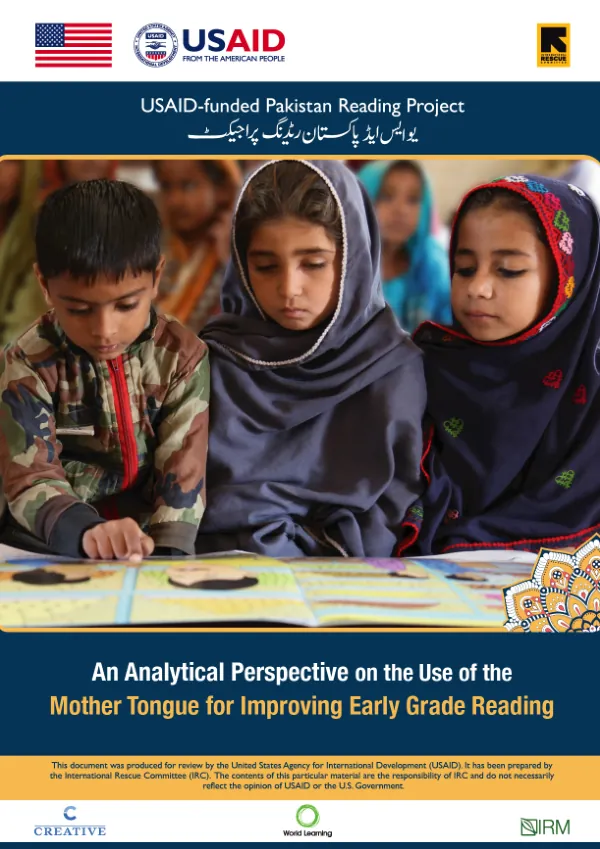
An Analytical Perspective on the Use of the Mother Tongue for Improving Early Grade Reading
Sign inINTERNATIONAL RESCUE COMMITTEE
An Analytical Perspective on the Use of the Mother Tongue for Improving Early Grade Reading
The choice of language of instruction has significant implications for a child's ability to acquire literacy in the early grades and, consequently, for lifelong learning.
2018 · 34 pages
Sign in to readA free account is required to download.
Abstract
In Pakistan, the policy on school languages has not always followed the established dictum of using the mother tongue or the language of the child's comfort as the medium of instruction. English, as the language of the elite, is considered a pre-requisite for the best jobs in the country, whereas Urdu, as the national language of identity, dominates political discourse and on-the-ground decisions on school language. The study explored various variables to analyze the impact of the current policy and its implementation in the classroom and to present recommendations. The variables examined include the child's comfort with different languages in early grades, teachers' proficiency in languages selected for instruction, and the difficulties faced by teachers in the classroom. Students were presented with a sheet of ten pictures and asked to name the objects in the language of their choice. A detailed questionnaire was administered to the teachers, supplemented with findings from other similar studies in the country and interviews with key informants. The study was conducted in select schools in seven districts of the four main provinces of the country: two each in Punjab, Sindh, and Khyber Pakhtunkhwa, and one in Balochistan. The data analyzed is indicative but not representative. Provinces with autonomy to choose the language of instruction in schools were selected to represent a diversity of policies. At the primary level, provinces may choose between three languages: Urdu, English, and the mother tongue, with Sindh province being the only one to have used the mother tongue as an option. The study found that neither English nor Urdu are languages of comfort for students other than possibly in Punjab. An overwhelming majority of students responded in either Urdu or the mother tongue, with the degree of the latter two varying across provinces. In Punjab, a majority of children were more comfortable in Urdu, but in other provinces, more students responded in the mother tongue. Haripur district of Khyber Pakhtunkhwa was the exception, as the majority of responses were in Urdu. Teachers' perceptions of students' comfort in languages also revealed that in Punjab, children mostly communicate in Urdu but also in many cases in the mother tongue. In Haripur, teachers believed that students are more comfortable in their mother tongue compared to Urdu when communicating with each other. In Sindh, Balochistan, and the Peshawar district of Khyber Pakhtunkhwa, the mother tongue was the language of first choice for children in informal conversation outside the classroom. Teachers' beliefs and practices appear to have a correlation with the official policy. In Punjab, Haripur district of Khyber Pakhtunkhwa, and Gwadar (Balochistan), teachers' perceptions and practices align with the official policy of using Urdu as the primary language of instruction. The study's findings suggest that the current policy of using English or Urdu as the primary language of instruction may not be effective in promoting literacy and lifelong learning. The study recommends that the policy be revised to take into account the child's comfort with different languages and the natural advantages of using the mother tongue as the medium of instruction. The study also recommends that teachers be provided with training and support to develop their proficiency in languages selected for instruction and to address the difficulties they face in the classroom.
Related documents
Documents in this collection
 2019
2019USAID DEC
Variation Study Midline Report: A Mixed-Methods Experimental Study with Four Treatment Arms to Identify the Cost-Effectiveness of Different Ingredients of a Literacy Intervention for Early Grades: Evidence from the Pakistan Reading Project in KP
Open record 2016
2016USAID DEC