USAID DEC
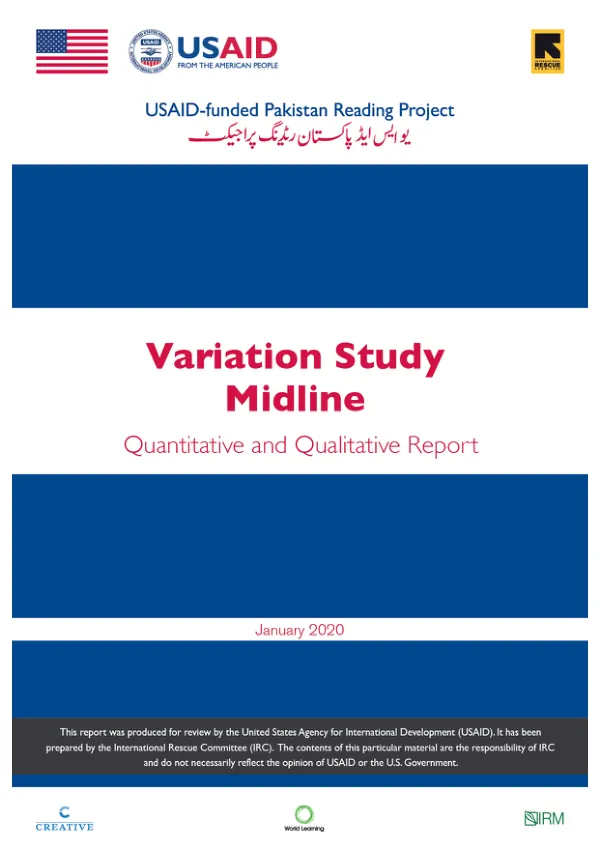
Variation Study Midline Report: A Mixed-Methods Experimental Study with Four Treatment Arms to Identify the Cost-Effectiveness of Different Ingredients of a Literacy Intervention for Early Grades: Evidence from the Pakistan Reading Project in KP
Sign inINTERNATIONAL RESCUE COMMITTEE
Variation Study Midline Report: A Mixed-Methods Experimental Study with Four Treatment Arms to Identify the Cost-Effectiveness of Different Ingredients of a Literacy Intervention for Early Grades: Evidence from the Pakistan Reading Project in KP
The Pakistan Reading Project, a literacy intervention for early grades, was implemented in Khyber Pakhtunkhwa (KP) province of Pakistan.
2019 · 86 pages
Sign in to readA free account is required to download.
Abstract
The project aimed to improve reading skills of students in grades 1-3 and instructional practices of teachers. A mixed-methods experimental study with four treatment arms was conducted to identify the cost-effectiveness of different ingredients of the literacy intervention. The study involved 3,068 students from 120 schools, with 2,413 students re-contacted at midline. The participants were randomly assigned to one of four treatment arms: face-to-face trainings, Teacher In-Service Group Support (TIGS), school support visits, or a combination of these interventions. The study used a mixed-methods sequential explanatory design, with quantitative and qualitative data collected at baseline and midline. The results showed that the literacy intervention had a positive impact on students' reading skills. The percentage of students receiving zero scores decreased by 15.6%, and the percentage of students meeting national reading standards increased by 12.1%. The average scores of students also improved by 10.3%. The study found that the combination of face-to-face trainings and TIGS had the greatest impact on students' reading skills. The study also examined the impact of the literacy intervention on teachers' instructional practices. The results showed that the intervention had a positive impact on teachers' instructional practices, with a 12.5% increase in the use of instructional practices. The study found that the combination of face-to-face trainings and school support visits had the greatest impact on teachers' instructional practices. The study also examined the impact of the literacy intervention on different subgroups of students, including girls, boys, students from different socio-economic backgrounds, and students from different home languages. The results showed that the literacy intervention had a positive impact on all subgroups, with the greatest impact on students from disadvantaged backgrounds. The study concluded that the literacy intervention was effective in improving reading skills of students and instructional practices of teachers. The study recommended that the literacy intervention be scaled up to reach more students and schools in KP province. The study also recommended that the literacy intervention be adapted to meet the needs of different subgroups of students. The study used a range of assessments, including the Early Grade Reading Assessment (EGRA) and the Teacher Classroom Observation (TCO) assessment. The EGRA assessment measured students' reading skills, while the TCO assessment measured teachers' instructional practices. The study used a difference-in-difference approach to estimate the impact of the literacy intervention on students' reading skills and teachers' instructional practices. The study's findings have implications for policymakers and educators in KP province. The study's results suggest that the literacy intervention is an effective way to improve reading skills of students and instructional practices of teachers. The study's findings also suggest that the literacy intervention can be adapted to meet the needs of different subgroups of students. The study's limitations include the use of a small sample size and the lack of control over external factors that may have affected the study's results. The study's findings should be interpreted in the context of these limitations.