USAID
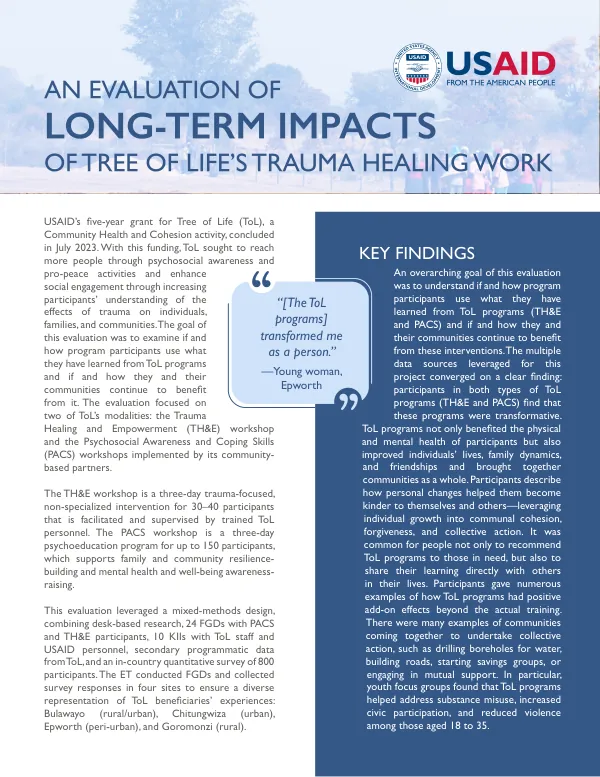
An Evaluation of Long-Term Impacts of Tree of Life's Trauma Healing Work
The Tree of Life (ToL) Community Health and Cohesiveness activity, funded by USAID, concluded in July 2023.
2023 · 2 pages
Sign in to readA free account is required to download.
Abstract
The program aimed to increase awareness and promote peace through social engagement through understanding the effects of trauma on individuals, families, and communities. The evaluation focused on two ToL modalities: the Trauma Healing and Empowerment (TH&E) workshop and the Psychosocial Awareness and Coping Skills (PACS) workshops implemented by community-based partners. The TH&E workshop is a three-day trauma-focused intervention for 30-40 participants, facilitated and supervised by ToL personnel. The PACS workshop is a three-day psychoeducational program for up to 50 participants, supporting family and community resilience-building, mental health, and well-being. The evaluation used a mixed-methods approach, combining desk research, 24 focus group discussions (FGDs) with participants, 10 key informant interviews (KIIs) with ToL staff and USAID personnel, secondary programmatic data from ToL, and a quantitative survey of 800 participants. The evaluation aimed to understand how program participants use what they have learned from ToL programs and if they and their communities continue to benefit from these interventions. The findings indicate that both TH&E and PACS programs were transformative, improving participants' physical and mental health, lives, family dynamics, and friendships. Participants reported personal changes, kindness, and kindness towards others, leveraging growth into communal cohesion, forgiveness, and collective action. They also shared their learning with others and recommended the programs to those in need. The evaluation found that ToL programs had positive add-on effects beyond the training, such as drilling boreholes, building roads, starting savings groups, and engaging in mutual support. In particular, youth focus groups found that ToL programs helped address substance misuse, increased civic participation, and reduced violence among those aged 18 to 35. Program participants described concrete and continuous benefits from ToL programs, stating that the skills they learned changed their lives. Uptake of skills from ToL programs was high, with both TH&E and PACS participants reporting an average of more than five skills used. The TH&E and PACS programs have different but complementary impacts. Beneficiaries described TH&E as more personally transformative on the healing journey, while PACS favored social reparation and cooperation. However, both programs contributed to improved social cohesion, collective agency, and productive cooperation at the community level. The evaluation recommends designing a follow-on program to build off ToL's successes, incorporating intensive, personalized, and longer-term care similar to TH&E, as well as community workshops and trainings like those offered in the PAC program. Future trauma healing program designs should consider a rapid-response mechanism to help programming during elections and times of political instability. The evaluation also suggests adding a focus on youth and school-aged children, given the qualitative data on the effectiveness of ToL for substance misuse, civic participation, and reducing violence among youth. The TH&E program has shown the most sustained, individual-level impact, and USAID should consider funding it as a successful trauma-healing intervention.
Related documents