THE NATURE CONSERVANCY
An Innovative Approach to Development: Public-Private Alliance Successes
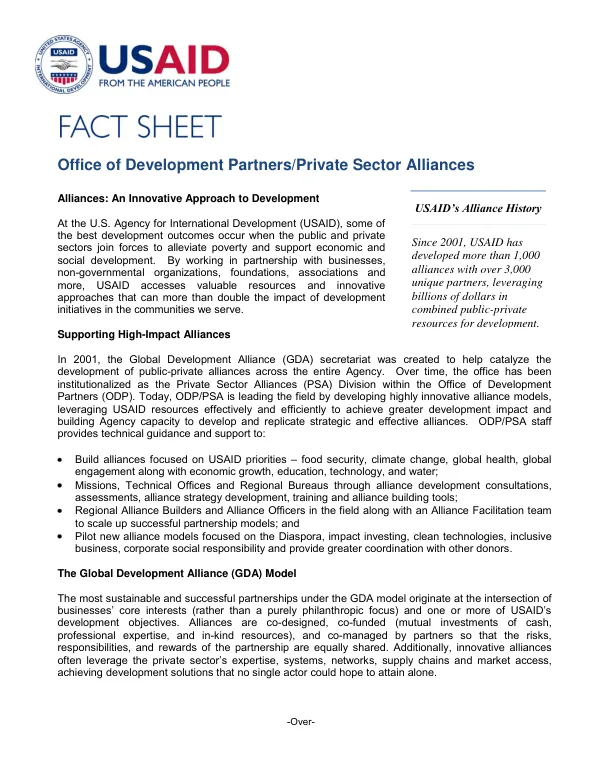
The Office of Development Partners/Private Sector Alliances plays a crucial role in promoting public-private partnerships to alleviate poverty and support economic and social development.
2 pages
Sign in to readA free account is required to download.
Abstract
By collaborating with businesses, non-governmental organizations, foundations, associations, and other stakeholders, USAID can leverage valuable resources and innovative approaches to achieve greater development impact in the communities it serves. The Global Development Alliance (GDA) was established in 2001 to facilitate the development of public-private alliances across the Agency. Over time, the office has been institutionalized as the Private Sector Alliances (PSA) Division within the Office of Development Partners (ODP). Today, ODP/PSA is leading the way in developing highly innovative alliance models, leveraging USAID resources effectively and efficiently to achieve greater development impact and building Agency capacity to develop and scale up strategic and effective alliances. The GDA model emphasizes the importance of partnerships that originate at the intersection of businesses' core interests and one or more of USAID's development objectives. Alliances are co-designed, co-funded, and co-managed by partners, ensuring that the responsibilities, rewards, and risks of the partnership are shared equally. This approach often leverages the private sector's expertise, systems, supply chains, and market access, achieving development outcomes that no single actor could attain alone. Since 2001, USAID has developed over 1,000 alliances with more than 3,000 unique partners, leveraging billions of dollars in combined public-private resources for development. These partnerships have had a significant impact on major development challenges, including poverty reduction, climate change, and access to safe drinking water. For example, the partnership between USAID and Starbucks has improved coffee quality, certified sustainable practices, and provided premium prices to local farmers, raising local incomes and raising the quality of production. Another successful partnership is the Regional Forestry Alliance, which aims to protect Asia's unique forest biodiversity. The partnership, which started in 2006 and runs through 2011, is working with forest producers in several countries in Asia to increase regional timber production from legal sources, improve the sustainability of forest management, strengthen regional cooperation, and contribute to climate change response. The program has been leveraged by $15.3 million in partner contributions, demonstrating the potential for public-private partnerships to achieve significant development outcomes. In addition to these examples, USAID has also partnered with local private sector companies to develop and distribute affordable water treatment solutions. The partnership with PT Tashia Consumer Products in Indonesia has provided over 717 million liters of safe drinking water to Indonesians, demonstrating the potential for public-private partnerships to address critical development challenges.
Related documents