USAID DEC
Analisis Filogenetik Ikan Tuna (Thunnus spp.) yang didaratkan di Pelabuhan Benoa, Bali
Sign inUSAID DEC
Analisis Filogenetik Ikan Tuna (Thunnus spp.) yang didaratkan di Pelabuhan Benoa, Bali
The genus Thunnus is a type of tuna that dominates the international market.
2021 · 5 pages
Sign in to readA free account is required to download.
Abstract
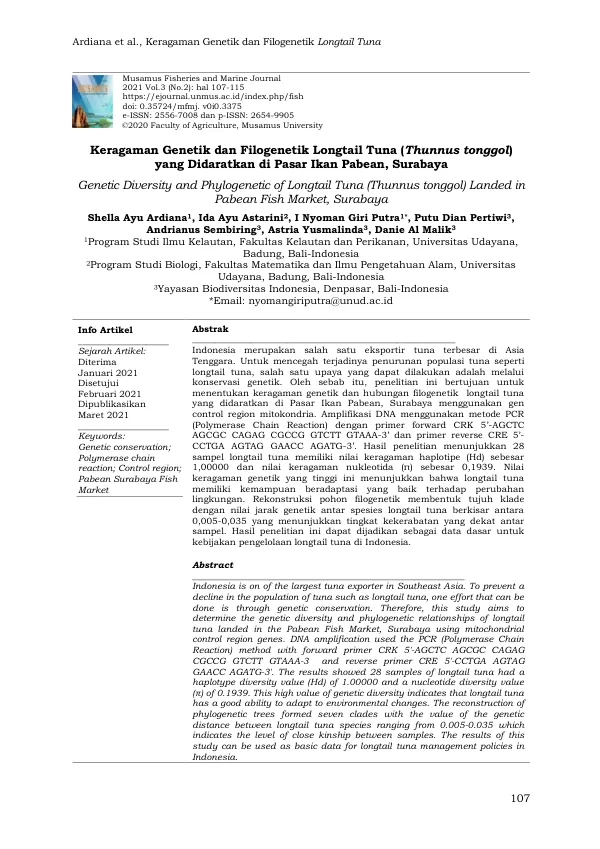
The genus Thunnus consists of seven species of tuna, including tuna mata besar (T. obesus), tuna sirip biru pasifik (T. orientalis), tuna sirip biru atlantik (T. Thynnus), tuna albacore (T. alalunga), tuna sirip kuning (T. albacares), tuna sirip biru selatan (T. maccoyii), and tuna albacares (T. albacares). Each species of Thunnus has its own distinct morphological characteristics, making identification challenging. DNA barcoding is a technique used to identify organisms using a specific DNA sequence. The control region (CR) of the mitochondrial DNA has been validated as a molecular marker for distinguishing species of Thunnus. This region is more effective than the standard DNA barcoding marker, CO1, in differentiating all species of Thunnus, including those in the subgenus NeoThunnus. Phylogenetic analysis is a technique used to model and visualize the relationships between species. In this study, the phylogenetic relationships between the species of Thunnus were analyzed using the mtDNA control region locus. The results showed that there are five species of tuna landed at Benoa Harbor, namely yellowfin tuna (T. albacares), longtail tuna (T. tonggol), bigeye tuna (T. obesus), southern bluefin tuna (T. maccoyii), and albacore tuna (T. alalunga). The phylogenetic tree reconstruction showed that all samples were divided into five clades according to the number of tuna species resulted from molecular identification. The genetic distance between clades ranged from 0.075 to 0.212, with the closest kinship found in yellowfin tuna (T. albacares) with bigeye tuna (T. obesus) and the farthest found in yellowfin tuna (T. albacares) with albacore tuna (T. alalunga). The study aimed to identify the species of Thunnus landed at Benoa Harbor and analyze their phylogenetic relationships. The results of this study will provide valuable information for the management and conservation of tuna resources in the region. The study also highlights the importance of using molecular genetic techniques, such as DNA barcoding, for species identification and phylogenetic analysis. The research was conducted at two tuna processing companies in Benoa Harbor, Bali, namely Bali Tuna Segar and Jaya Kota. A total of 47 samples were collected from the two companies, representing the catch from the Indian Ocean and the Flores Sea. The samples were identified morphologically and then subjected to molecular analysis using the mtDNA control region locus. The DNA extraction was performed using the Chelex 10% method, which is a rapid and practical method for extracting DNA from fish samples. The PCR amplification was carried out using the mtDNA control region primers, CRK and CRE, which are universal primers for identifying genetic and population variations in tuna. The PCR products were then analyzed using gel electrophoresis to check the quality of the DNA. The phylogenetic analysis was performed using the Neighbor Joining method with 1000 bootstrap replicates. The results showed that the five species of tuna landed at Benoa Harbor are closely related, with the closest kinship found in yellowfin tuna (T. albacares) with bigeye tuna (T. obesus) and the farthest found in yellowfin tuna (T. albacares) with albacore tuna (T. alalunga).