USAID DEC
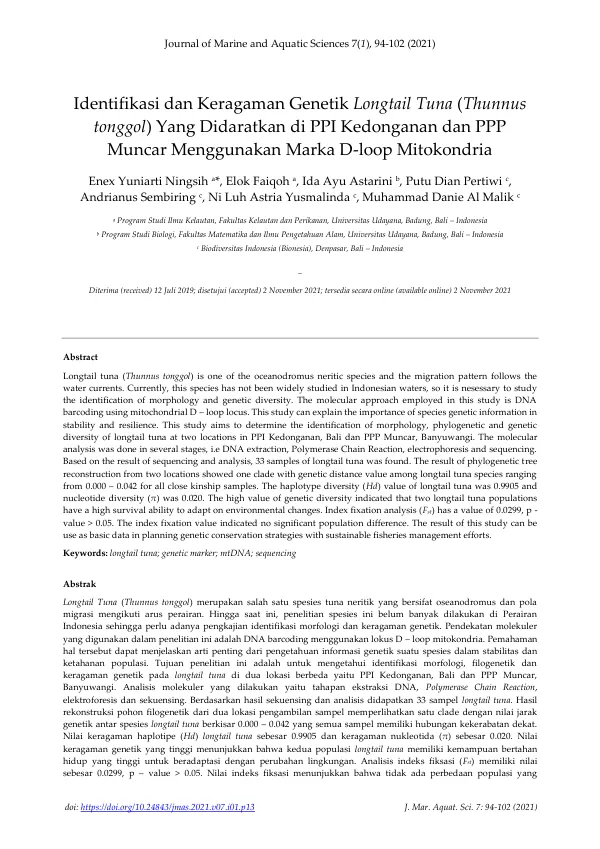
Genetic variation of longtail tuna Thunnus tonggol landed in four fish markets in Indonesia based on mitochondrial DNA
Sign inUSAID DEC
Genetic variation of longtail tuna Thunnus tonggol landed in four fish markets in Indonesia based on mitochondrial DNA
Genetic variation of longtail tuna Thunnus tonggol landed in four fish markets in Indonesia was studied based on mitochondrial DNA.
2021 · 8 pages
Sign in to readA free account is required to download.
Abstract
The research aimed to determine the genetic diversity and potential population structure of longtail tuna in Indonesia. A total of 101 samples were identified and confirmed as T. tonggol species by amplifying and sequencing a fragment of the d-loop region. Neighbor-joining analysis resulted in a topology with all samples grouped into one clade with an average genetic distance of 0.020. Haplotype diversity (Hd) and nucleotide diversity (π) values of the longtail tuna samples were 0.9939 and 0.0192, respectively. The fixation index (Fst) value was -0.00507, with p> 0.05, indicating that there is no significant population structure among the longtail tuna collected from four fish markets representing three sampling locations. The results of this analysis can be used as basic data in planning sustainable fisheries management efforts. Longtail tuna is an economically valuable neritic species found in tropical and subtropical waters in the Indo-Pacific region. High catch numbers, which have been decreasing, could negatively impact this tuna's population level. Little research has been conducted on the longtail tuna population in Indonesia. The longtail tuna has a coastal distribution in the Indo-Pacific region and is being exploited by commercial fisheries in several countries throughout the Indo-Pacific. Decreasing numbers of the longtail tuna catch raise concerns that genetic variation of longtail tuna is being decreased as a result of exploitation. Genetic conservation strategies that incorporate molecular identification methods to determine species identity will more accurately reveal the status and health of fish populations. It is essential to understand the genetic information of longtail tuna as a basis for guiding sustainable fisheries resource management policies. DNA barcoding techniques provide fast and accurate means for identifying cryptic organisms. The d-loop or control region is a non-coding gene that is often used in species delimitation and population analysis. This mtDNA locus is involved in the control of mtDNA replication and transcription processes and has relatively high mutation and polymorphism rates, rendering nucleotide sequences that vary greatly between individuals. The study aimed to complement understanding of the genetic diversity of T. tonggol by determining the genetic diversity and potential population structure of landed longtail tuna obtained from four fish markets in Indonesia. The d-loop mitochondria DNA marker was used to investigate the population structure of longtail tuna across the study areas. Understanding longtail tuna populations will help identify genetic stocks, which would be an important source of information to help policymakers in managing sustainable fisheries of this species in Indonesia. Sample collections were conducted from December 2018 to June 2019. Fin clips of longtail tuna were collected from four fish markets in Indonesia, including Bali, Banyuwangi, Surabaya, and Batam. Samples were preserved in 96% ethanol before being transported to the laboratory for DNA extraction. Interviews with local fishermen were conducted to confirm the catch location of the longtail tuna samples, which were within 50 miles offshore of each port. Molecular analysis was carried out at the Yayasan Biodiversitas Indonesia (Bionesia) Laboratory, Bali. DNA extracts were isolated using 10% chelex. Extracted DNA was then used to amplify, using Polymerase Chain Reaction (PCR) methods, a fragment of the mitochondrial DNA (mtDNA) control region (d-loop) locus. PCR methods were carried out following the methods in Allen et al. (2017) using the forward primer (CRK) and reverse primer (CRE). Each PCR reaction was 22 μl in volume, consisting of reagent solution containing 12.5 μl ddH2O, 2.5 μl 10x PCR buffer (PE-II), 2.5 μl dNTP, 2.0 μl MgCl2, and 1.25 μl primary CRK-CRE and 0.125 μl of PE Amplitaq, and 3 ul of DNA template. Sequences were edited and aligned using the CLUSTAL W algorithm in MEGA X. A distance-based topology was obtained using the Neighbor-Joining method with the Kimura 2-parameter model. The results of this analysis can be used as basic data in planning sustainable fisheries management efforts.